



Samay Raina’s Still Alive and the Question India Won’t Answer: Why Can’t We Take a Joke?
Samay Raina’s Still Alive moves beyond comedy to question India’s uneasy relationship with humor after the India’s Got Latent controversy. As outrage, censorship and changing boundaries collide, the big question remains: Are we really ready to laugh without limits?
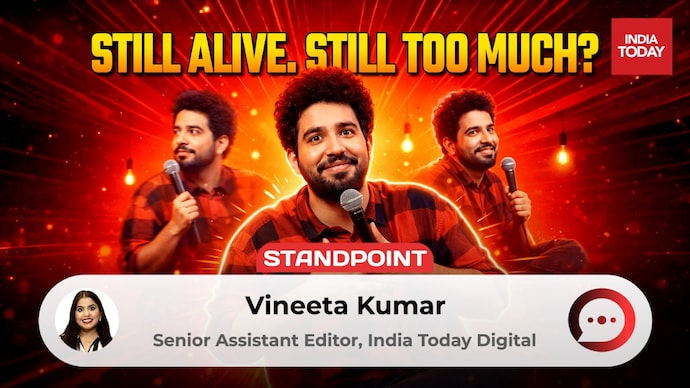

Raina’s time still alive He never made such a statement during the show India’s Got Latent Controversy. He then took to the stage for his first stand-up Ranveer Allahabadia controversyAnd talked about what happened on the show, during that shoot, among fellow comedians, within his family, among his audience, and inside his own mind.
He expressed his views. He made people laugh a lot. But somewhere between the punchlines, he asked a bigger question: Are we ready for him, for this kind of comedy? For latent season 2Or are we still negotiating what we can laugh at and what we can’t?
❮❯
As the controversy over Allahbadiya’s incest joke escalated, Raina had to remove every episode of his hugely popular show from YouTube. In still aliveHe announced the return of the show for what he called a second season, “Wild Wild”. He did this in the same breath when he talked about FIRs, outrage, threats and the speedy deletion of his work.
That contradiction is hard to ignore. The return and fall that he talked about sits in the same sentence.
The outrage over that one comment exposed much more than a bad joke. This revealed something about us. A society that is morally quick to police, slow to contextualize, and increasingly comfortable with punishment: FIRs, threats, cancellations, without knowing where to stop. When does disagreement end and destruction begin?
Nothing much has changed in a year. Just a few days ago, comedian Zakir Khan had made fun of its success. Dhurandhar: RevengeThe reaction from sections of the film industry was sharp. Crimes were committed, statements were issued, lines were drawn. again.
So what are we actually reacting to? Joke? Intention? Or the anxiety of being laughed at?
It seems our appetite for humor is selective. We enjoy it, but on our own terms. As long as it remains safe, harmless, predictable. As it spreads – toward politics, society, power or even personal discomfort – it begins to feel like a threat. Then comedy ceases to be entertainment and starts becoming an intrusion.
History supports this method. We don’t fully understand what roast is, but we react to it. We rehash old jokes and suddenly they seem offensive. We remind comedians of their “limitations.” Almost as if we’re constantly drawing a line, and redrawing it, depending on what’s bothering us that day.
That’s actually the real issue: not the joke, but the instability of the line. Because what are we really saying to comedians? Be funny, but don’t be sarcastic. Make us laugh, but don’t make us think. Entertain us, but don’t question – don’t question the system, don’t question us.
Over time, we have turned comedians into safe artists – stripped of their right to provoke, criticize or opine. As long as the jokes are goofy, they are acceptable. As they become intelligent, they become riskier.

still alive, which aired on Tuesday night, Pushed against him. This was no ordinary comedy set. It seemed like an attempt to reclaim this space, to show that stand-up could go beyond self-deprecation, beyond observational humor. something that holds a mirror. Not only for the comedian’s life, but also for the audience’s reality.
But the question is, are we ready? Are we willing to listen without immediately reacting? Sitting with the discomfort rather than shrugging it off? How to distinguish a bad joke from a bad intention? To criticize without destroying? Disagreement is necessary. Accountability is necessary. But does FIR make a better audience? Do bullies make better comedians? Does deleting someone’s entire work correct a mistake, or silence future efforts?
There is a difference between calling and closing. It seems we blur it out too easily.
Sarcasm, subtlety, discomfort – these are not accidents in comedy. This is where comedy thrives. These are its tools. Without these the humor becomes hollow. Of course, context matters. Of course, you can’t say anything and hide behind joke labels. And yes, in an emotional country like ours, words carry weight.
Freedom of expression cannot exist without responsibility. This is true. But another question is equally important: Are we, as a society, living up to our responsibility as we respond? Or are we choosing resentment because it’s easier than engagement?
The past year has shown that the problem is not about comedians crossing boundaries, but about the lines changing with our moods.