



Researchers create world’s smallest robots, they claim they are smaller than a grain of salt and extremely cheap
Researchers have created the world’s smallest autonomous robot which is smaller than a grain of salt. These programmable microscopic machines could transform the medical and engineering fields with their unique swimming and sensing capabilities.

They swim, think and even react to their environment, and they’re smaller than a grain of salt. Researchers at the University of Pennsylvania and the University of Michigan have unveiled the world’s smallest fully-programmable and autonomous robot. These microscopic machines may one day change the way doctors and engineers work on the smallest scale. According to media reports, manufacturing these micro robots is also more cost-effective. Each of these robots, measuring about 200 by 300 by 50 micrometres, costs just a penny to build and can operate for months. Despite their size, they have impressive abilities: they can move independently, sense changes in temperature and adjust their path, all without any external control such as magnetic fields or wires.
microscope robot
Powered entirely by light, the robots use small solar panels that provide energy to their onboard computers. These chips allow them to “think” and act autonomously, which is a first for devices of this size. This breakthrough is so significant that Mark Mishkin, the lead researcher and assistant professor of electrical and systems engineering at Penn Engineering, summed it up as, “We’ve made an autonomous robot 10,000 times smaller. This opens up an entirely new scale for programmable robots.”
Unlike larger robotic systems that move using physical joints or mechanical limbs, these microscopic machines use an elegant alternative. They generate an electric field that induces ions in the surrounding liquid, which in turn exerts pressure on nearby water molecules to propel the robot forward. By varying the electric field, the robots can move in complex patterns or even swim together like a small school of fish.
This innovative design also means they have no moving parts, making them incredibly strong. Some have already demonstrated the ability to travel at speeds of up to one body length per second, which is remarkable for something smaller than a speck of dust.
How a robot smaller than salt can “think”
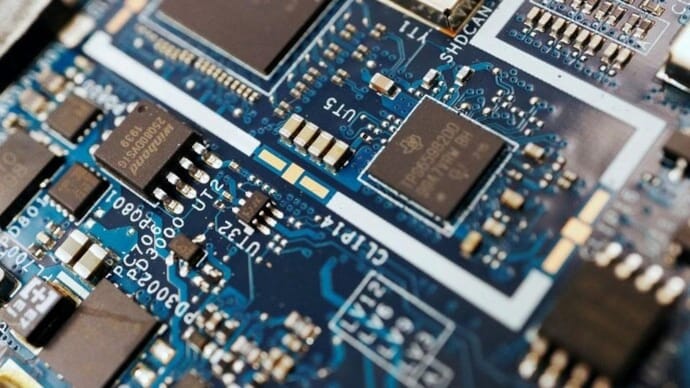
Building a truly autonomous robot on this scale was no small feat. To operate independently, each unit requires a miniature computer, sensors, propulsion controls and a power source, all squeezed into a chip that’s a fraction of a millimeter across.
To make this possible, the Michigan team developed ultra-low-power circuits that consume a thousand times less energy than conventional electronics. This allowed small processors to run efficiently on the limited energy supplied by their microscopic solar panels.
Since solar cells occupy most of the robot’s surface area, the researchers had to fit the processor and memory in the remaining portion of the space. The result is a marvel of miniaturization, what the team calls the first sub-millimeter robot that can actually think. To their knowledge, no one before had managed to pack a true computer consisting of a processor, memory and sensors into something so small.

Robots can also measure temperature with an accuracy of about a third of a degree Celsius, allowing them to sense changes in heat or move towards warmer areas. This accuracy can make them invaluable in medical research, such as monitoring the health of individual cells or tracking cellular activity in real time.
In the future, researchers plan to make robots smarter and more versatile. They envision models that can store more complex programs, move faster and handle more extreme environments. Because the current design is modular and inexpensive, it could serve as a platform for a new generation of microscopic machines capable of doing everything from repairing tissues to assembling nanoscale structures.
From cost-effective manufacturing to astonishing miniaturization, these salt-sized robots are redefining what’s possible in robotics. As Professor Miskin and his team say, this is just the beginning, a glimpse of a future where fleets of microscopic machines could swim through our bodies or create devices too small for human hands to touch.