



Project Hail Mary review: Ryan Gosling’s film blends science and heart just right
Project Hail Mary Movie Review: Project Hail Mary is a refreshing science fiction film that beautifully balances scientific intrigue with heartfelt emotion, showcasing Ryan Gosling’s nuanced performance at its core.
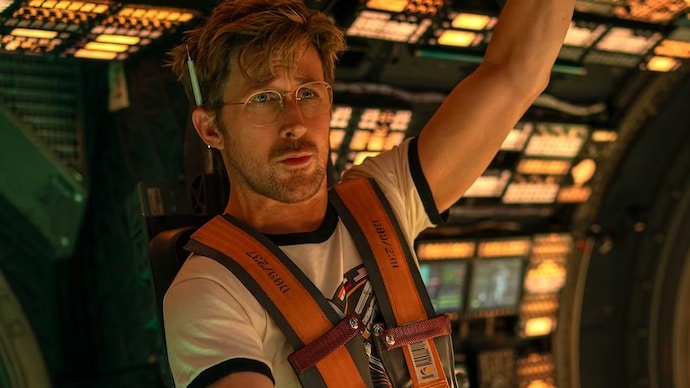

There is a quiet defiance in the heart of Project Hail Mary. At a time when science fiction is increasingly obsessed with the collapse of order, morality, hope, this film chooses something far riskier: optimism.
Directed by Phil Lord and Christopher Miller, and adapted from Andy Weir’s best-selling novel, Project Hail Mary There is a fine line between pretense and honesty. On the surface it is about a dying sun and humanity’s last gamble. But underneath it all, it’s about connection: who we trust, who we become in crisis, and what it means to not be alone at the end of everything.
❮❯
At its center is Ryan Gosling’s Ryland Grace, a man who wakes up in deep space with no memories and, gradually, no illusions about humanity. Gosling plays Grace with disarming awkwardness, leaning toward vulnerability rather than heroism. His performance is deeply visceral, with humor, fear and reluctant courage in equal measure, and it anchors the film even when the science threatens to overpower the emotions.
Visually, the film is immersive without being indulgent. Its visual style encapsulates both the vastness of space and the power of stillness. The space is not romanticized; It is observed. The camera lingers on confined interiors, sterile surfaces and the vast, indifferent emptiness outside. There is a deliberate avoidance of excess, no unnecessary visual noise, no exaggerated spectacle. This measured approach allows isolation to be overcome. You are constantly aware of how precarious human existence is in a setting that offers no second chances.
Adapting Weir’s dense, problem-solution-heavy novels was always a challenge. Screenwriter Drew Goddard has cleverly pared down the excess without diluting the essence. The science remains accessible, even playful, integrated into the narrative rather than hindering it. Fans of the book may look past the missing layers of technical detail, but what the film gains in return is emotional clarity. It understands that the story isn’t just about saving the Earth, it’s also about why it matters.
And that “why” comes into sharp focus with Rocky.
Without going into spoiler territory, the relationship between Grace and Rocky, an alien creature who is, quite literally, rock-like, is the film’s most surprising triumph. Their camaraderie is not based on equality, but on curiosity. On patience. The slow, deliberate action of understanding someone who is fundamentally different from yourself.
In a cinematic landscape that seems to bet entirely on grand romances and tragic partnerships, this bond feels refreshing. It is devoid of ego, politics or power. – Just two creatures, trying to survive, choosing kindness when it would be easier not to. In many ways, it’s more intimate than any love story we’ve seen on screen in recent years. Because it is built on faith, not desire.
What is revealed about Grace makes this relationship even more fascinating. As the film progresses, a subtle but surprising change occurs, he begins to find more comfort in this alien companionship than in his memories of human contact. It’s a troubling idea, but also a deeply contemporary one. Because Project Hail Mary At its core, it is a reflection of our present.

While the central crisis of Dying Sun is fictional, the behavioral patterns that emerge from it are not. When faced with extinction, systems begin to prioritize survival over morality, and decisions become transactional, even if it costs human lives in the trade. The narrative reflects a world already grappling with resource concerns, broken alliances and competing interests.
In that context, Grace’s emotional inclination towards Rocky seems more like commentary than escapism. What does it say about humanity if solace is easily found outside humanity? If empathy feels more accessible within species than across boundaries? And yet, the film never becomes cynical.
This is its biggest strength. This shows that cooperation, no matter how delicate, is still possible. That connection, no matter how unlikely, can still save us. There are flaws. The film runs a bit long, and sometimes when it does move forward, its emotional beats get interrupted. There come such moments when sentimentality lasts only for a short while. But these are minor detours in an otherwise impressive journey.
because when Project Hail Mary works, and it does often, it reminds you why science fiction matters. Not for the scale, not for the spectacle, but for the questions it asks. Who are we when everything is at stake? And who do we choose to stand with? In answering it, the film finds something rare: not just surprise, but warmth.
Project Hail Mary Will be released in India after a slight delay on March 26. Dhurandhar: Revenge.