





OpenAI employee says AI will replace researcher jobs before engineers and sales teams
An OpenAI employee has reportedly said that researchers could be replaced by AI before engineers and sales teams, challenging common assumptions about which jobs are the most secure. Here’s everything you need to know.




An unusual claim about the future of jobs inside AI labs has sparked new debate online, and it comes from someone who says the message came straight from OpenAI’s own corridors. According to Yuchen Jin, co-founder and CTO of Hyperbolic Labs, an OpenAI researcher privately told him that researchers would be replaced by AI before infrastructure engineers and before sales teams.
Jin shared comments on Although he did not say who made the comment, the idea immediately gained attention because it goes against the popular belief that engineers would go first.
Jin reveals why AI will eliminate researcher jobs at OpenAI ahead of engineering roles
Jin himself admitted that at first glance the idea seemed strange. But he also explains why it’s not as far-fetched as it seems. In his view, a large part of the research work involves coming up with ideas and running experiments, tasks that AI systems are already good at. He said most research follows known patterns, and AI can already generate hypotheses, test variations and analyze results at a speed that humans cannot. He made an exception, noting that top-level researchers who push the boundaries of the field may still be hard to replace.

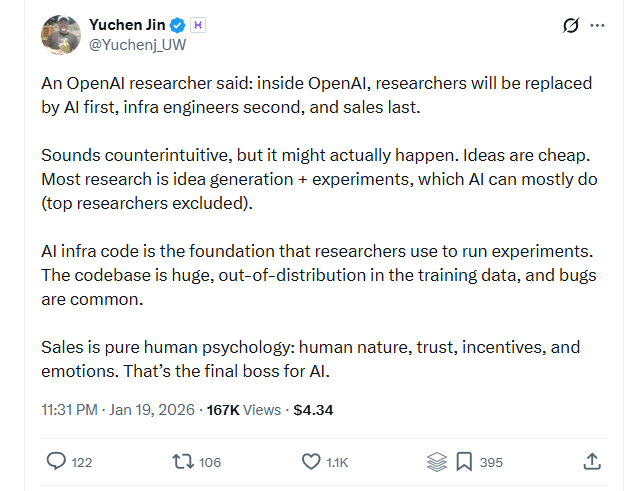
Infrastructure engineers sit in a very different position, Jin argued. The systems powering AI training and deployment are massive, disorganized, and full of state-of-the-art matters. These codebases often differ from anything found in public training data, and bugs are common. Even if AI can write code, such systems remain difficult to manage and fix because the cost of errors is very high. According to Jin, all AI labs roughly know how to train models, but it is the quality of the infrastructure that decides how fast teams can move and how good the final models will be.
However, sales teams are a completely different story. Zinn described sales as an area deeply connected to human psychology – trust, motivation, relationships and emotion. These are areas where AI still struggles to perform consistently well. He jokingly called sales the “final boss” for AI, suggesting that it may be the last major role where humans clearly outperform machines.
The post drew reactions from other engineers and researchers. A software engineer named Sergei Nikiforov responded that he had always assumed that infrastructure roles would be automated at first, but after reading Jin’s explanation he agreed. He pointed out that real-world infrastructure code is often cluttered and full of exceptions that are difficult for AI to navigate. Jin responded by emphasizing how disorganized and complex the AI laboratory infrastructure actually is, saying that teams like Thinking Machines could benefit from building them from the ground up.
Although the discussion did not include any timeline for when such changes might happen, it comes at a time when OpenAI itself is facing heavy churn at the top. In the summer of 2025, the company reportedly lost more than half a dozen researchers to Meta, which is investing billions in its superintelligence lab.


Among those leaving were Jason Wei and Ziqing Sun, both research scientists who joined Meta in July. Another researcher, Heung Won Chung, also took this step and spoke publicly about his enthusiasm for building systems “from a clean slate.” Perhaps the most high-profile exit was ChatGPT and GPT-4 co-creator Shengjia Zhao, who became chief scientist at Meta’s Superintelligence Lab and now works closely with Mark Zuckerberg.
Other notable departures include Jiahui Yu, who played a major role in developing multimodal capabilities in OpenAI, and Hongyu Ren, a core contributor to GPT-4O. Shuchao Bi, who worked on reinforcement learning and multimodal systems, also left for META. These exits follow a previous wave of leadership changes in 2024, when OpenAI saw the departure of senior figures such as CTO Mira Muratti, Chief Research Officer Bob McGrew, and Vice President of Research Barrett Zoff. Today, CEO Sam Altman is one of only two remaining members of OpenAI’s original founding team.
AI replacing human jobs is nothing new; Big tech companies have already started doing this
The broad idea of AI taking over human jobs is not new, and many large companies have already talked openly about it. A July 2025 Microsoft report analyzing 200,000 Copilot conversations found that AI could take over a large portion of the work done by historians, coders, salespeople, journalists, and data scientists. Around the same time, Amazon CEO Andy Jassy said that AI-driven efficiency would reduce the company’s corporate workforce over the next few years.
IBM has gone even further, replacing hundreds of roles with AI and automating most routine HR tasks. At the same time, IBM’s leadership argues that AI has helped the company grow by freeing up money and people for other areas, rather than simply cutting jobs. In a 2025 podcast interview, Salesforce CEO Marc Benioff said the company had reduced its customer support workforce from about 9,000 employees to about 5,000 after implementing agentic AI systems to handle a larger portion of support tasks. Many other tech companies are laying off thousands of employees in the name of saving money to invest in certain business areas, while some are outright admitting that they want to invest in AI.