



On Friday, March 20, 2026 at 14:46 GMT, Earth does what it has done for billions of years. The Sun crosses the celestial equator, day and night achieve their perfect balance and spring, indifferent to the wars and reigns below, arrives on schedule. In Tehran, where jasmine petals reportedly fall through the air and still carry traces of smoke from recent air strikes, families are setting haft-sin tables with trembling hands. In Mumbai, Parsi families, dressed in white, light the sacred fire that has been burning without interruption for more than a thousand years. In London, Los Angeles and Toronto, Iranian expatriates are opening bottles of rose water and planting vegetables in clay pots, crying silently in both. This is Nowruz. It has been coming to this exact astronomical moment, on this very day, for at least 3,000 years. Any empire that tried to stop it was gone. The festival is still here.
What exactly is Nowruz?
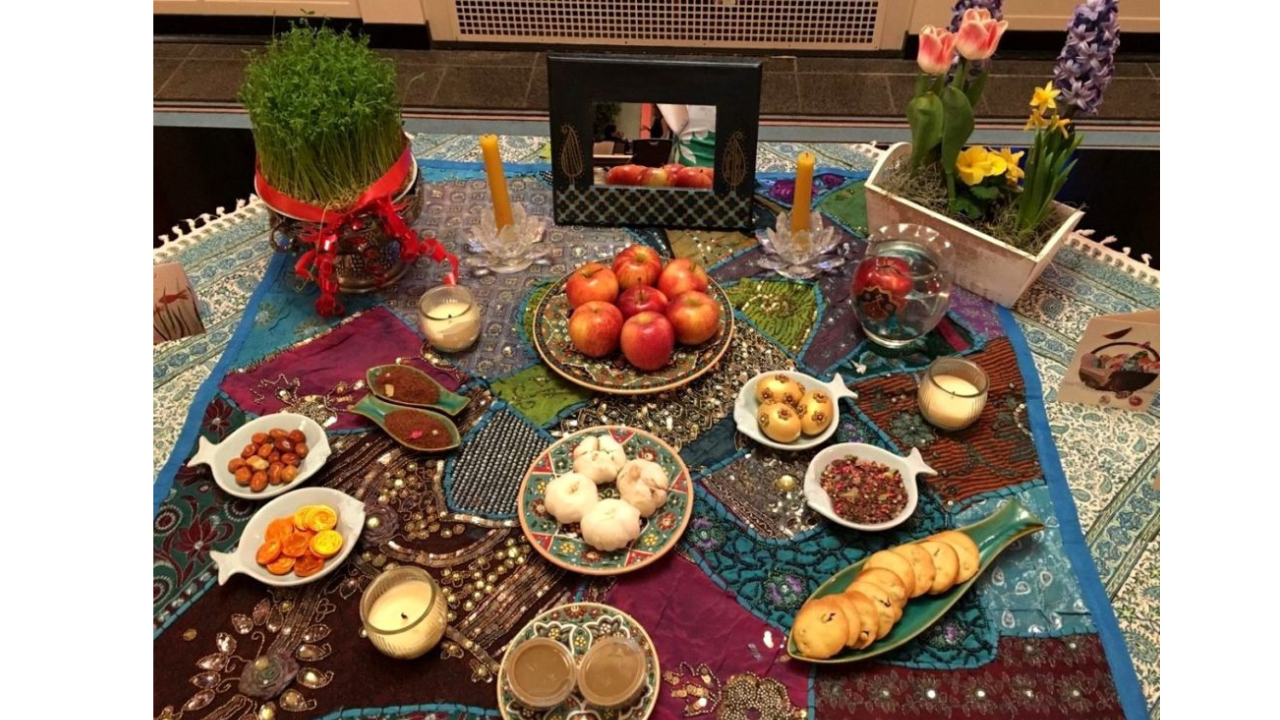
Before politics, bombs and theology, there is astronomy.Nowruz, which translates as “New Day” in Persian, is based on the spring equinox, the precise moment when the Sun crosses the celestial equator and the hours of daylight and darkness achieve perfect balance. It is not an ongoing ceremony tied to any lunar calendar or any ecclesiastical order. This is a planetary phenomenon. Its timing is determined by the Earth’s orbit and nothing else.The centerpiece of the festival is the Haft-Sin table, a ceremonial spread of seven items, each of which begins with the Persian letter “sin”, which is equivalent to the letter S. Each has its own symbolism: vegetables, sprouted wheat or lentils representing rebirth; Samanu, a sweet wheat pudding symbolizing prosperity; Senjade, the dried fruit of the lotus tree, represents love; Garlic for medicine and health; Apple, apple for beauty; Somak, the sumac berry symbolizes sunrise and the triumph of good over evil; And Serkeh, vinegar represents age, patience and wisdom. A mirror, candles, colored eggs and a goldfish in a bowl.It is a table that has been established in some form or another for three millennia. That is not a metaphor. This is a fact.
Born in the fire: Parsi origin
To fully understand Nowruz, one must begin not with Iran but with the religious imagination of a prophet named Zoroaster, known in Persian as Zarathustra, the exact dates of which remain one of academia’s more spirited controversies. Mary Boyce, a prominent Western scholar of Zoroastrianism and author of the definitive three-volume work A History of Zoroastrianism, placed Zoroaster between 1500 and 1000 BCE, making his religion older than Buddhism, older than Judaism as a codified faith, and centuries older than Christianity or Islam.Zoroaster’s theology was revolutionary. He proposed a universe defined by a cosmic conflict between Ahura Mazda, the supreme power of light, truth and goodness, and Angra Mainyu, the power of darkness and destruction. Fire was sacred, a visible symbol of divine light on earth. The spring equinox, when light finally triumphs over darkness after a long winter, was the most spiritually charged moment in the Zoroastrian calendar. Nowruz was its celebration.Under the Achaemenid Empire, the dynasty founded by Cyrus the Great in 550 BC, Nowruz became a formal royal occasion. According to historian Pierre Bryant, author of From Cyrus to Alexander: A History of the Persian Empire, the kings of Persia held grand Nowruz receptions at the ceremonial capital Persepolis, receiving delegations and tributes from across the known world. The reliefs on the walls of Persepolis, still visible today, depict these processions. Nowruz was not just a festival. This was a claim to civilizational identity.
Arab conquest and the great dispersal
In 637 AD, Arab armies defeated the Sassanid Persian Empire at the Battle of al-Qadisiyah, and the world that had sustained Nowruz for more than a millennium began to fall apart. Within two decades, Persia had completely fallen. Islam replaced Zoroastrianism as the dominant faith, often by force, sometimes by encouragement, and the Parsi community, the very people who had created and sustained the festival, found themselves strangers in their own homeland.Historian Richard Foltz, in his book Religions of Iran: From Prehistory to the Present, describes how Zoroastrians were classified as dhimmis under Islamic rule, a protected but clearly subordinate status that made them subject to jizya, a special tax imposed on non-Muslims. Conversion was encouraged through both social pressure and material benefits. For generations, what had been one of the world’s great religious civilizations had been reduced to a threatened minority on the margins of its own birthplace.Those who refused to convert ran away. The most significant migration took a community of Parsi refugees by boat across the Arabian Sea to the northwest coast of India, where, according to tradition, they landed in Gujarat around the 8th or 10th century AD. The local ruler, Jadi Rana, agreed to give them shelter. They became Parsis, Persians, and they brought Nowruz with them, called it Nowruz, retained its customs for fourteen centuries in a land that was not their own.Today the global Parsi population numbers approximately 100,000 to 200,000 people. From one of the great empires in history to a community smaller than the population of a medium-sized English town. This, in its most serious form, ultimately resulted in Arab conquest.
The celebration that the winners couldn’t celebrate

And yet Nowruz did not die in Persia. This is the paradox at the core of the festival’s story and this fact makes it truly extraordinary.The Arab conquerors who destroyed Zoroastrianism could not destroy the spring equinox. Persian Muslims, generation after generation, continued to set the Haft-Sin table, plant vegetables, jump into the fire of Chaharshanbe Suri on the Tuesday before the New Year, and gather with family at the time of the equinox. The great Persian poets writing under Islamic rule, Hafez, Rumi, Omar Khayyam, and Ferdowsi, all celebrated Nowruz in their poetry without obvious religious discomfort. Ferdowsi’s Shahnameh, a 10th-century national epic that deliberately preserved pre-Islamic Persian identity, placed Nowruz at the center of Persian civilization. This was an act of cultural disobedience in the guise of literature.As scholar Ervand Abrahamian writes in his landmark work A History of Modern Iran, Persian identity constantly reasserted itself against Arabization throughout the Islamic period, and Nowruz was the most visible and best-loved means of that reassertion.
Khomeini, Khamenei and the war on spring
When Ayatollah Ruhollah Khomeini came to power in 1979, he wasted little time in clarifying his position on Nowruz. He publicly condemned it as a pagan tradition incompatible with Islamic rule, and his regime moved against it on several fronts. State television ended its Nowruz programme. The traditional two-week public holiday was shortened. Religious authorities issued a fatwa questioning the permissibility of the festival. Chaharshanbe Suri’s fire-jumping ceremony was targeted as particularly dangerously pagan, with police breaking up public ceremonies.In a direct historical echo, the regime seemed to be completely unaware that it had aligned itself with the Arab conquerors of the 7th century, who had attempted the same thing and failed for the same reasons.It failed again. Iranians who agreed to ban alcohol, enforce the hijab, and dismantle secular institutions drew a line in Nowruz that the regime could not cross. The families celebrated privately. Fires were lit in the back streets. The Haft-Sin table appeared in the living room behind a closed curtain. And slowly, humiliatingly, the Islamic Republic retreated. Nowruz was back on the official calendar by the late 1980s. By the time Ali Khamenei succeeded Khomeini in 1989, the Supreme Leader was giving an annual Nowruz address to the nation, the same tradition his predecessor had sought to end.As journalist and Iran scholar Robin Wright observed in his book The Last Great Revolution: Turmoil and Transformation in Iran, the Islamic Republic’s failure to suppress Nowruz revealed a fundamental truth about the limits of divine power. The government can control what people wear, drink, and say in public. But it can’t control what people bring inside.This could not control the Parsi grandmother in Mumbai, who has laid her own Navroz table every year for eighty years, keeping alive the tradition that her ancestors carried across the Arabian Sea in exile, rather than handing it over to any conqueror. This could not control the Persian poet who transformed Nowruz in his verses under a Caliph who would be better off forgetting it. This could not control the Iranian mother who planted her sabzi on a windowsill in the midst of a revolution in Tehran in 1982, which declared the festival incompatible with God. It could not control the children who jumped into the fire of Chaharshanbe Suri in the back streets when the roads were closed to them. Today, the festival unites the diverse cultures of Iran, Central Asia, the Caucasus, the Balkans and beyond, offering a rich tapestry of customs, traditions and shared values.The empires are defeated by the armies. But cultures are kept alive by ordinary people who, generation after generation, century after century, stop remembering who they are. This is the story of Nowruz. This has always been the story of Nowruz.
Morning of March 20, 2026
This Nowruz comes under any adverse circumstances in living memory.Following US-Israeli military operations against Iran’s nuclear and military infrastructure and the reported death of Supreme Leader Ali Khamenei in attacks on Tehran in February 2026, the country that tried hardest in modern history to suppress Nowruz finds itself in the middle of a war whose outcome is unwritten. Iranians inside the country have reported setting up their haft-sin tables under the sky, with smoke still lingering in the air. “Planting vegetables is something we Iranians do every year,” Kamran, a 42-year-old office worker in Hamedan, told Iran International. “But this year, with all the news about the war, we completely forgot about it.”Meanwhile, in Mumbai, London and Toronto, Parsi families light their sacred fires and celebrate Navroz with full spirit, meaning this special year, unlike anything their community has experienced in fourteen centuries. Those who celebrated the festival outside Persia in exile are watching from afar as the land they left burns in a conflict whose resolution, for the first time in 1,400 years, may open the question of what Persia will become next.No one can answer that question tonight. But at 14:46 GMT, the answer to at least one question will be provided with absolute certainty, as has been the case every year for three thousand years.spring is here. Nowruz is here.