



No, government clarifies, India is not pressurizing phone brands to share source code
The government has rejected claims that smartphone brands will be forced to share source code, saying discussions on mobile security are still in the consultation stage and there is no final rule.


The Indian government has moved to clarify the situation after reports that smartphone makers may soon be forced to hand over their source code under a new security effort. The government termed these claims as false and said that no such proposal is on the table and the current discussion is being misunderstood.
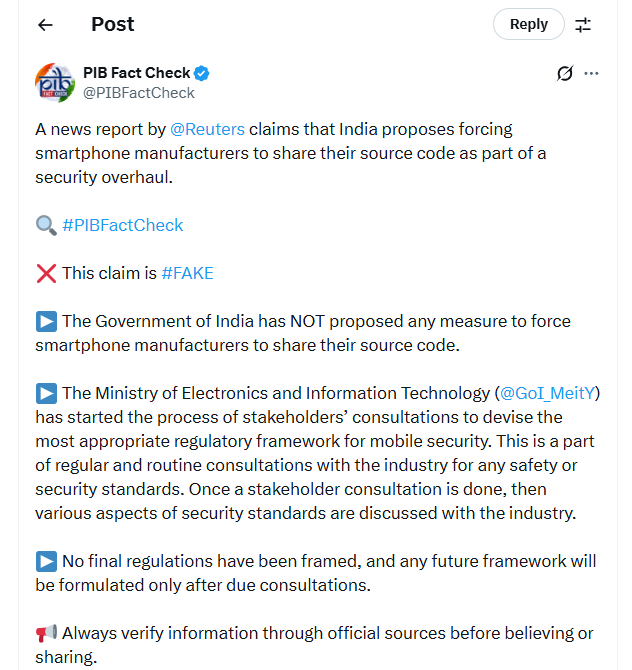
In a public clarification posted by the PIB Fact Check account on Twitter, the government directly refuted a Reuters report that claimed India was planning to mandate sharing of source code by smartphone brands. According to PIB, the claim is false. The Ministry of Electronics and Information Technology (MeitY) has not proposed any measure that would force companies to share their source code with the government.
The government explained that what is actually happening is a regular consultation process. MeitY has initiated discussions with industry stakeholders to explore an appropriate regulatory framework for mobile security. These consultations are part of the normal process followed before implementing or updating safety and security standards. Officials stressed that no final rules have been made yet and any future framework will come only after detailed discussions with the industry.
The clarification comes after a Reuters report said India was considering a wide range of new security requirements for smartphones, including access to source code, alerts to the government about major software updates and other software-level changes. The report said these proposed standards have triggered internal resistance from global smartphone giants like Apple and Samsung, with the companies arguing that such measures could expose sensitive proprietary information and have no global precedent.
The Reuters report links the proposed security standards to a broader government effort to improve user data security in India, especially as online fraud and data breaches continue to rise in one of the world’s largest smartphone markets. Citing unnamed sources and confidential documents, it claimed that the requirements were part of the draft Indian Telecom Security Assurance Requirements prepared in 2023 and now being considered for legal endorsement.

However, government officials have urged caution in paying too much attention to these discussions. IT Secretary S. Krishnan told Reuters earlier that it would be “premature” to draw conclusions and that any genuine concerns raised by the industry would be addressed with an open mind. A ministry spokesperson also said that detailed comments could not be shared as consultations with companies were still ongoing.
The Reuters report also outlined several other measures that are reportedly being discussed, such as allowing users to uninstall pre-loaded apps, limiting background access to cameras and microphones, mandatory malware scanning, giving advance notice of software updates to government bodies and storing system logs on devices for up to a year. Industry body MAIT, which represents several global smartphone brands in India, was quoted as opposing many of these ideas, arguing that they could impact user experience, battery life and software rollout timelines.