



New year, new pain: Everything from phones to laptops is going to be expensive in 2026
The prices of smartphones and laptops are going to increase in the next few weeks and months. Due to shortage of RAM, prices may rise by 20 to 30 percent in 2026.
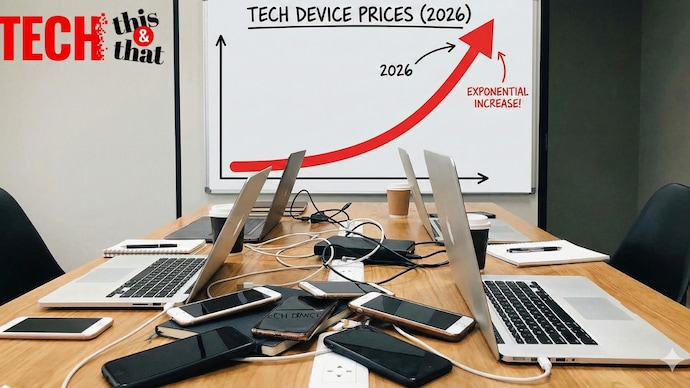

Prices rise because inflation is always increasing, sometimes slowly and often rapidly. But in 2026, there is going to be another kind of increase in the prices of gadgets including smartphones and laptops. This is a price increase caused by a shortage of components and is so severe that tech companies will either be forced to reduce the capabilities of their machines, which is not a good option, or prices will increase significantly in 2026. This is already happening but is going to pick up pace as we move deeper into 2026. It’s all because of RAM.
RAM supply is running so low that already major laptop makers Asus and Dell have announced price hikes of up to 30 percent on their 2026 lineups.
RAM is a component that is at the center of the price crisis facing the tech industry. From Microsoft to Samsung, from Lenovo to Asus, everyone is worried about it. Still, there is little they can do as the world is suddenly hit with RAM supply problems. A major factor in this is AI and AI companies. Drunk with money, they are pushing traditional companies out of the RAM supply chain. So much so that other companies may have to increase the prices of their phones and laptops by about 20 to 30 percent in 2026 to remain profitable.
ram cases
To understand the issue, first of all we have to understand what role RAM plays in a computer. And take a look at things like HBM (high bandwidth memory) and AI inference. RAM is an important part of a computer, whether it is big or small. Everything that “computes” has random access memory (RAM). This is because RAM is where the computer holds data while it is actively being used. Example: Your Chrome browser. While the application resides on the hard disk, once you open it and access a website, it moves to RAM and remains there until you close the tab and browser. Similarly, gamers might have seen that “loading” screen whenever they opened a game. That loading is basically moving data from the hard disk to RAM so that the phone or computer can actively use the data.
Generally, more RAM means better overall performance of the phone or computer. Everyone who makes a computer or phone or tablet or similar gadget needs RAM, and they need it at the cheapest prices and in the maximum possible quantities. Once we move beyond the basics, there are different types of RAM. The one that is causing all the problems these days is HBM.
HBM is a RAM built not for speed but for endurance due to its extremely high bandwidth rate. It is also very expensive and until 2020 was used mainly in high-end graphics cards.
This rapidly changed with the advent of ChatGPT, Google Gemini, and other AI tools. These AI systems drink HBM the same way your neighborhood bodybuilder drinks his protein shake.
The AI systems powering ChatGPIT and Gemini require as much HBM as companies can supply them, and as the demand for AI has grown over the past few years, it has also increased the demand for HBM from companies like Google and Nvidia that are building key infrastructure for AI. Also, with more data centers coming online, the demand for regular RAM has also increased rapidly.
As of 2024, prices were still in control, due to old supply agreements. But as RAM-makers – and there are only three big ones and they are Samsung, SK Hynix and Micron – enter into new supply agreements, they are now demanding huge sums from cash-rich AI companies.
AI companies are willing to pay. But supplies are so tight that they can’t even get HBM. At any cost. Recently, there was a report from Korea, a major RAM manufacturing country, that Google and Microsoft employees were making rounds of the offices of Samsung and others, in hopes of striking new supply agreements. His companies reportedly told him to either take the supply deals or leave.
From phones to laptops, everything will be expensive in 2026
This brings us to the pricing conundrum facing phones and laptops in 2026. RAM is manufactured largely by three technology companies. They have limited capacity and are chasing the biggest margins, which is currently in manufacturing of HBM which is worth its weight in gold. So, not only are they increasing HBM production and prices, but they are also cutting back on manufacturing of regular DDR and GDDR RAM. These are typical RAM sticks that we can plug into a laptop or desktop. They also come in chip form and are used by phone manufacturers inside their devices.
The price of this RAM has increased by almost 3X to 5X in a year. It is selling at huge margins by the end of the year compared to its price at the beginning of 2025. This is one reason why OnePlus recently hinted at the price of OnePlus 15 and called it an achievement for the company. It is priced at Rs 72,999, which, according to the company, is a marginal increase from the price of the OnePlus 13 despite a huge increase in “component costs”.
But the way things are going, Rs 72,999 may look like a basement bargain in 2026. Officially, the phone companies are keeping quiet. But as laptop launch season begins January 6 with the Consumer Electronics Show in Las Vegas, laptop makers are talking.

According to reports, Dell has recently announced a hike in the prices of its laptops for 2026 in a memo to its retailers. A report from Business Insider said the price increase would be “between 10 percent and 30 percent.” A few weeks ago, Dell COO Jeff Clark highlighted rising component costs. “We haven’t seen costs increase at the pace that we’ve seen,” Clark said. “Demand far outstrips supply.”
Meanwhile, Asus has officially announced its price increase. In a letter to its partners in Korea, and as reported by Korean DigiTimes, Asus clearly blamed RAM shortages as the reason behind the price increase: “Structural instability in the global supply chain is putting continued pressure on the costs of key components, especially memory (DRAM) and storage components (NAND and SSD),” the company noted in its letter. “After carefully reviewing market conditions, supply stability and our commitments to product quality, ASUS plans to implement strategic price adjustments for certain product combinations starting January 5, 2026.”
The company hasn’t specified what kind of enhancements we can expect. But this would be in line with what Dell has done.
Asus and Dell are among the world’s largest computer manufacturers. If they are raising prices, it is safe to say that Lenovo, Acer and others will also raise their prices. Apple remains a secret horse in this aspect because the company, due to its size and weight, has more long-term supply chain agreements. But it’s likely that Apple will also raise prices for its MacBooks, depending on what kind of pressure its supply chain is feeling.
Should you buy a phone or laptop now?
If you need it, it wouldn’t be a bad idea. Get one now. Given the current crisis – and opportunity for some – in the RAM market, it’s safe to say that phone and laptop prices will increase from now until 2026. Possibly sometime after 2026, and perhaps mid-2027, they will begin to settle again as companies make changes and adjustments to their supply lines, but until then a rise in prices seems inevitable.
Aside from the price increase, it’s likely that fewer promotions and sales will hit the market in 2026, and while some of these promotions will occur, the deals will most likely be modest. The rising prices of RAM are going to be a heavy burden on everyone including your pocket. Chances are you won’t be able to do much. The choice will be between paying more or settling for devices with less RAM and storage.