





Nayakan revisited in 2025: What’s old, what’s not in Kamal Haasan’s classic
‘Nayakan’ has been re-released in 2025 to celebrate Kamal Haasan’s 70th birthday. The film’s themes of vigilante justice and patriarchy invite renewed debate over its legacy.

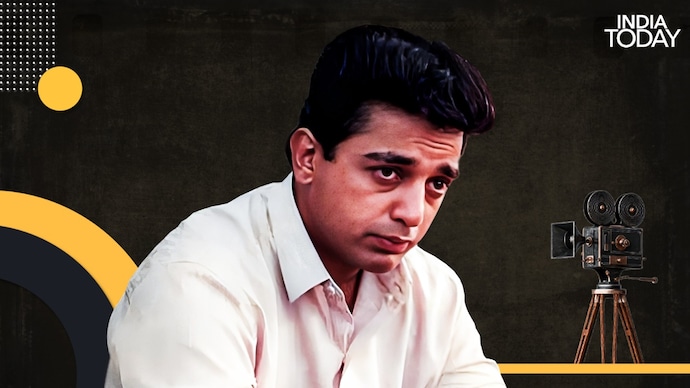


Ninga Nallavara Illa KettavaraAre you a good person or a bad person?
When grandson Sakthivel asks this question to the powerful Velu Naicker (Kamal Haasan), who is on his knees outside the court, his entire life flashes before him. Killings, standing up for one’s people and lending a helping hand do not answer the vague question. Even his famous line, ‘Naalu perukku nalladhu na edhuvum thappila (If it helps four people, there is nothing wrong in it),’ It did not seem right to present this as a small child’s answer.
The essence of Naicker’s life is depicted in this one scene. Kamal Haasan’s brilliant acting and the skill of director Mani Ratnam made ‘Nayakan’ an epic which remains so even today. The 1987 film was a watershed moment not only for Tamil cinema, but for Indian cinema as a whole – it was a film that inspired many people to pursue careers in cinema.
‘Nayakan’ was re-released in theaters on November 6 this year, a day before Kamal Haasan’s 70th birthday. And the re-release was a fitting celebration to honor legends like Kamal Haasan and Mani Ratnam.
Why does Nayakan remain great?
‘Nayakan’, the crime drama, revolves around the growth of Velu Naykar, an orphan from Thoothukudi – who moves to Mumbai to live in the Dharavi slums – and becomes the kingpin of the Bombay (now Mumbai) underworld.
The film addressed many burning topics that are still relevant today. From police brutality to land rights, Kamal Haasan’s Nayakkar plays the role of a vigilante who stands up for the people of Dharavi. Velu’s involvement in smuggling is justified by the fact that the money coming in is used to help the people in his slum. There is also an angle of discrimination and harassment, where an ambulance refuses to come inside the area because they live in a slum.
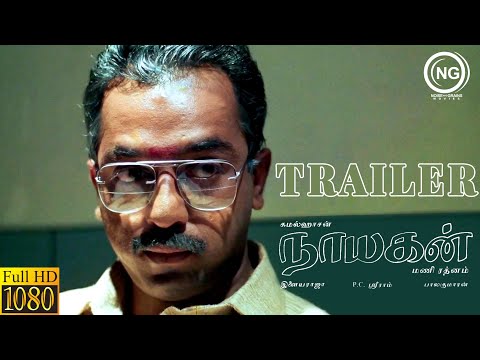
A film released in 1987 was also praised for its anti-establishment stance. This arose directly from the state’s failure to protect the Tamil community living in the slums of Bombay. Velu Naicker’s traumatic encounter with a police officer, who used his vulnerability to kill his union leader father, left a deep impact on him. Even in the years that followed, the police system did not help the community in which he grew up. This established Naicker as a morally compromised messiah, where he established himself as his own government to provide justice, security and welfare.
The theme of ‘Nayakan’ still recurs in Indian films and remains a topic of discussion even after three decades. The film also offers a nuanced perspective on the evolution of Kniker. Although he is involved in trafficking and murder, he still gets a chance to reflect and see the consequences before his eyes.
Naicker becomes a self-reflective man, and all this when he starts losing sight of his family. When Ghati arrives home, he begins to question his actions, starting with what had started for a noble cause. When he sees the police unleashing terror on his people and an old woman setting herself on fire to save her from the police, he wants to surrender and end everything.
haven’t aged well
‘Nayakan’ is a landmark film, but watching it in 2025 warrants a critical reassessment: while its core story and artistry remain powerful, some of its themes and narrative choices no longer align with today’s values, forcing us to question its legacy in a modern context.
Romanticization of vigilante justice
Engaging with Nayakan in 2025 means considering how its central claim – that vigilante justice is noble and restorative – might clash with modern calls for institutional reform. The film forces the audience to ask: can violence committed by a well-intentioned don ever be justified as community service? Although its tragic ending hints at the consequences, the main narrative still invites admiration for this problematic solution, making it a central aspect of the inquiry today.
lack of female agency


Take, for example, the scene where Naicker ties the mangalsutra to Neela (Saranya Ponvannan) while she is praying in the temple. His intentions are clear: he wants to free her from prostitution and give her a respectable life. But, isn’t her consent being sought before tying the knot? Not so good in 2025. Similarly, Neela and Charumathi are beautifully performed, but narrowly written – these women are defined entirely by their relationship with Naicker. Despite Naicker’s good intentions, the Mangalsutra scene takes away Neela’s agency at the very moment it claims to liberate her. Irony is largely missing in the film.
ancestral conflict
In another scene, where his daughter Charumathi (Karthika) talks to Naykar and his associate Selva (Janagaraj) about killing people, he takes his friend’s side and slaps his daughter. He immediately realizes his mistake, but the damage is already done. The immediate physical resort to silent protest, even if immediately regretted, exposes the patriarchal vestiges of the film’s era.
thug life comparison
Looking back at ‘Nayakan’ one also remembers the remnants of ‘Thug Life’, which reunited Kamal Haasan and Mani Ratnam after 38 years. While ‘Nayakan’ impressed everyone, ‘Thug Life’ failed to impress due to its poor script. But it was filled with many subplots that were underdeveloped, something where ‘Nayakan’ excelled due to its sharp focus on Nayakkar’s development. Both films have a gangster at their core. ‘Thug Life’ is about an aging gangster who wants to take revenge on those who cheated him. But, it was filled with several subplots that were underdeveloped, something where ‘Nayakan’ excelled due to its sharp focus on Nayakkar’s development.
‘Nayakan’ remains a major achievement in Indian cinema – a film that elevated the craft of storytelling, performances and visual poetry. Mani Ratnam and Kamal Haasan created a character study so structured and so profound that it continues to inspire filmmakers even after nearly four decades. Its anti-establishment politics and its frank depiction of state brutality will remain relevant even in 2025.
Does the presence of old politics diminish Nayakan’s artistry? Not completely. Great art can transcend flawed politics. The question is whether we, as viewers, can hold both truths simultaneously – that a film can be both a reflection of the blind spots of its times and also a masterpiece of craft. The haunting question of the courtroom scene: “Are you a good man or a bad man?” Was for Velu Naicker. But perhaps, in 2025, that’s a question we should be asking of the film itself. Like Naicker’s silence, the answer also remains complex.