



Microsoft will replace all C and C++ code with Rust, hints that 1 engineer will have to write 1 million lines every month
Microsoft is planning a significant overhaul of Rust, using an AI-powered system to rewrite its legacy C and C++ code on an unprecedented scale.

Microsoft may be preparing one of the most ambitious internal code changes the software industry has seen in years. A senior engineer at the company has publicly outlined a long-term plan that aims to remove every line of C and C++ code from Microsoft’s products by the end of the decade. The idea, shared via a job-related LinkedIn post, points to a future where large, complex codebases are rewritten at unprecedented speed using a combination of artificial intelligence and algorithm-driven systems. Although this claim seems exaggerated at first glance, the details suggest that Microsoft is already laying the groundwork to make this achievable.
Microsoft will replace all C and C++ code with Rust, hints that 1 engineer will have to write 1 million lines every month
The plan was revealed by Galen Hunt, a senior Microsoft engineer who has served at the company for nearly 28 years. They also announced an open position for a Principal Software Engineer (IC5), based in Redmond. In his post, Hunt clearly stated his goal to eliminate all C and C++ code at Microsoft by 2030. The replacement language of choice is Rust, which has steadily gained popularity for system-level programming due to its focus on memory safety and performance without relying on garbage collection.
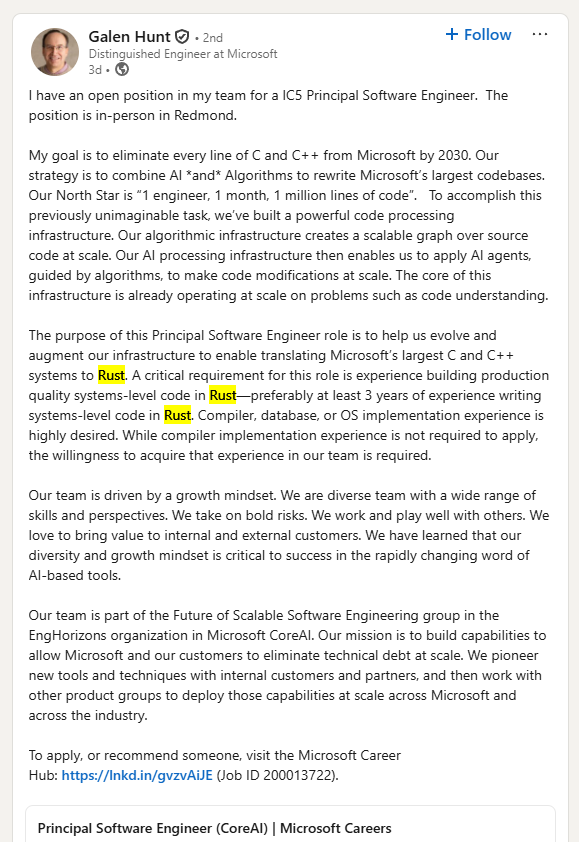
What stands out most in Hunt’s post is what he calls the team’s “north star” metric: one engineer, one month, one million lines of code. This goal hints at the scale at which Microsoft wants to work. Traditionally, rewriting even a few thousand lines of legacy system code has been considered risky and time-consuming. Microsoft’s approach attempts to overturn that perception by using AI agents guided by algorithmic systems to modify and translate code at scale.
According to Hunt, Microsoft has already built a powerful code-processing infrastructure to support this effort. At the algorithmic level, the system builds a scalable graph on the source code, which allows it to understand relationships and dependencies in very large codebases. On top of this is an AI processing layer that implements AI agents to make code modifications, with algorithms controlling those changes to maintain correctness and structure. Hunt said the core of this infrastructure is already running at scale, particularly on tasks related to code understanding, which is an important first step before any large-scale translation can occur.
The newly announced Principal Software Engineer role aims to further advance this infrastructure, specifically enabling the translation of Microsoft’s largest C and C++ systems to Rust. The job description makes it clear that this is not a theoretical or practical role. Candidates are expected to have strong, real-world experience writing production-quality, system-level Rust code, preferably for at least three years. Experience in areas such as compilers, databases or operating systems is described as highly desirable, underscoring the low-level and performance-critical nature of the work involved.
While compiler experience is not mandatory at the time of application, Hunt emphasized that anyone joining the team should be prepared to develop that expertise. This requirement states that the translation process will go beyond simple syntax conversion and will potentially include deeper changes in the system’s behavior, optimized and verified at runtime.

Hunt also revealed the team culture behind the initiative. He described the group as driven by a growth mindset, comfortable taking bold risks and built on diverse skills and perspectives. According to him, this mindset is essential at a stage where AI-based tools are rapidly changing how software is built and maintained. The team’s overarching mission is to help Microsoft, and ultimately its customers, eliminate technical debt on a large scale rather than slowly settling it.
Organizationally, the team sits in the Future of Scalable Software Engineering group under Microsoft’s EngHorizons organization, which is part of Microsoft CoreAI. Its mandate goes beyond internal tooling. The group’s goal is to first advance new technologies with internal teams and then work with other product groups to deploy those capabilities broadly across Microsoft and potentially the broader software industry.
Although Microsoft hasn’t formally announced a company-wide order to deprecate C and C++, Hunt’s post offers a rare glimpse of how seriously the company is thinking about large-scale code modernization.