



Meta fired 15,000 employees, the founder of Oculus was once fired by Mark Zuckerberg, called it a good decision
Meta has announced fresh layoffs at its Reality Labs division as it pivots from heavy virtual reality spending to focus on AI wearables. Following the announcements, Oculus founder Palmer Luckey, who was once fired by the company, is now defending Meta’s decision to make job cuts, calling it a necessary step for the long-term health of the VR ecosystem.
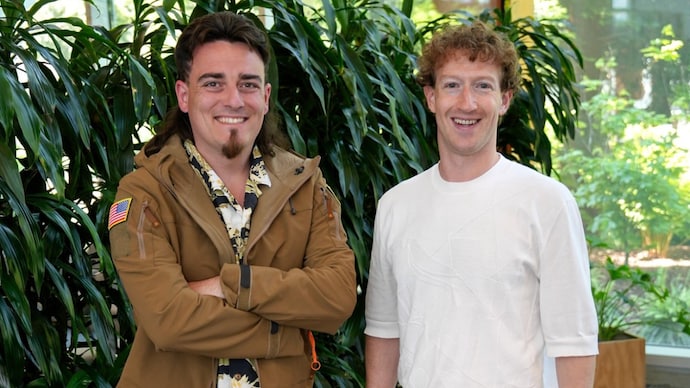

Meta recently announced another round of job cuts, slashing more than 1,000 roles from its Reality Labs division. While these layoffs are being seen as a sign of crisis, fueling fears of automation and even criticism that Mark Zuckerberg is stepping back from failed bets on virtual reality and the metaverse, Oculus founder Palmer Luckey has come out in support of the move. Luckey, who was once fired by Meta following a controversy over his political views, believes this decision could actually help Meta strengthen the VR ecosystem in the long run.
In a lengthy post on X, Luckey said his viewpoint runs contrary to the VR industry and media comments. “This is not a disaster. They still employ the largest team working on VR by orders of magnitude. No one is even close. The ‘Meta is abandoning VR’ narrative is patently false. The 10% layoff is basically six months of normal churn concentrated into 60 days, strictly by the numbers,” he wrote, pushing back against claims that META is moving away from virtual reality.
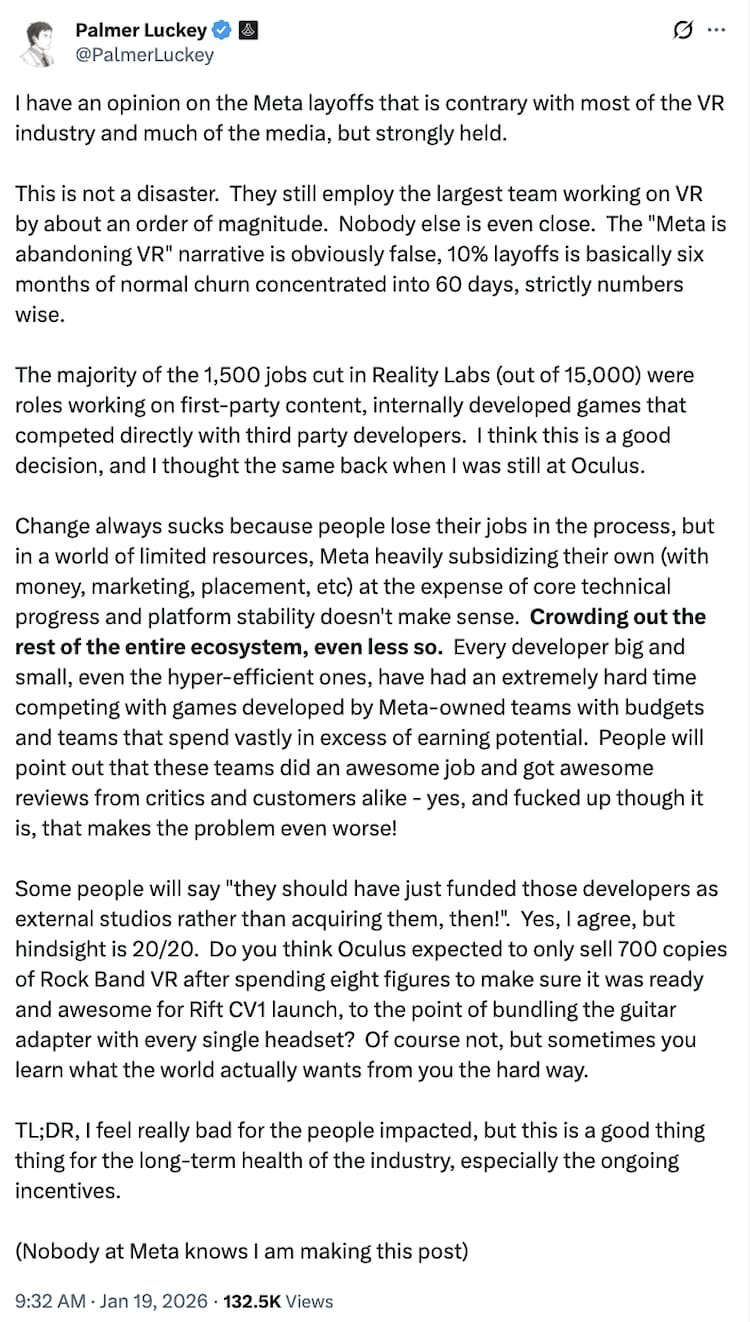
Luckey argued that the scale of the layoffs, estimated at about 10 percent of Reality Labs, was being exaggerated. While acknowledging the shock and pain caused by such concentrated cuts, he suggested that the layoffs do not fundamentally change Meta’s position as the dominant force in VR development.
To support his stance, Luckey highlighted that the majority of the approximately 1,500 jobs eliminated at Reality Labs were tied to first-party content teams, internal studios developing games that compete directly with third-party developers. In his view, this internal competition distorted the market. He suggests that Meta’s owned teams, backed by deep pockets, marketing support and favorable platform placement, have made it extremely difficult for independent developers to compete sustainably.
“There is no point in driving out the rest of the ecosystem. Every developer, large and small—even ultra-skilled developers—have faced an extremely difficult time competing with games developed by meta-owned teams whose budgets far exceed their earning potential.”
Notably, Luckey was once a key part of Meta’s VR ambitions, but he was fired from the company, then known as Facebook, following controversy over a donation he made to a pro-Trump group. Although Facebook initially denied that his departure was politically motivated, Luckey was fired in March 2017 after a period of leave. His exit remained a point of public controversy for years. However, by 2026, Lucky and Meta have officially reconciled and are collaborating on military technology projects.

Meanwhile, Luckey’s comments come as Meta is restructuring Reality Labs amid mounting financial pressure. According to Bloomberg report, more than 1,000 employees are being laid off from the division which employs about 15,000 people. Affected employees were reportedly informed via an internal post from Chief Technology Officer Andrew Bosworth.
As part of the cuts, Meta is also said to be reducing some virtual reality investments to make the business more sustainable, while shifting its focus to AI-powered wearables and mobile-first experiences. At the same time, Meta is increasing its push into AI hardware, including discussions with Essilor Luxottica SA to expand production of smart glasses.