



Detailed analysis of samples returned from asteroid Ryugu has revealed the presence of all five canonical “letters” of DNA and RNA, a discovery scientists say strengthens the case that the basic ingredients for life may be widespread throughout the Solar System.The discovery, published in the journal Nature Astronomy, comes from material collected by Japan’s Japan Aerospace Exploration Agency during its Hayabusa2 mission, and represents the most comprehensive chemical examination to date of one of the oldest objects in our cosmic neighborhood.
What scientists found and why it matters
At the center of the discovery are nucleobases, molecular components that encode genetic information in DNA and RNA. These include adenine, guanine, cytosine, thymine, and uracil, which are often described as “letters” that form the instructions for life.For the first time in Ryugu samples, researchers confirmed the presence of all five.Toshiki Koga, a biogeochemist at the Japan Agency for Ocean-Earth Science and Technology and lead author of the study, cautioned against over-interpreting the discovery, telling AFP via Phys.org: “This does not mean that life existed on Ryugu. Instead, their presence indicates that primitive asteroids may produce and preserve molecules that are important for chemistry related to the origin of life.”
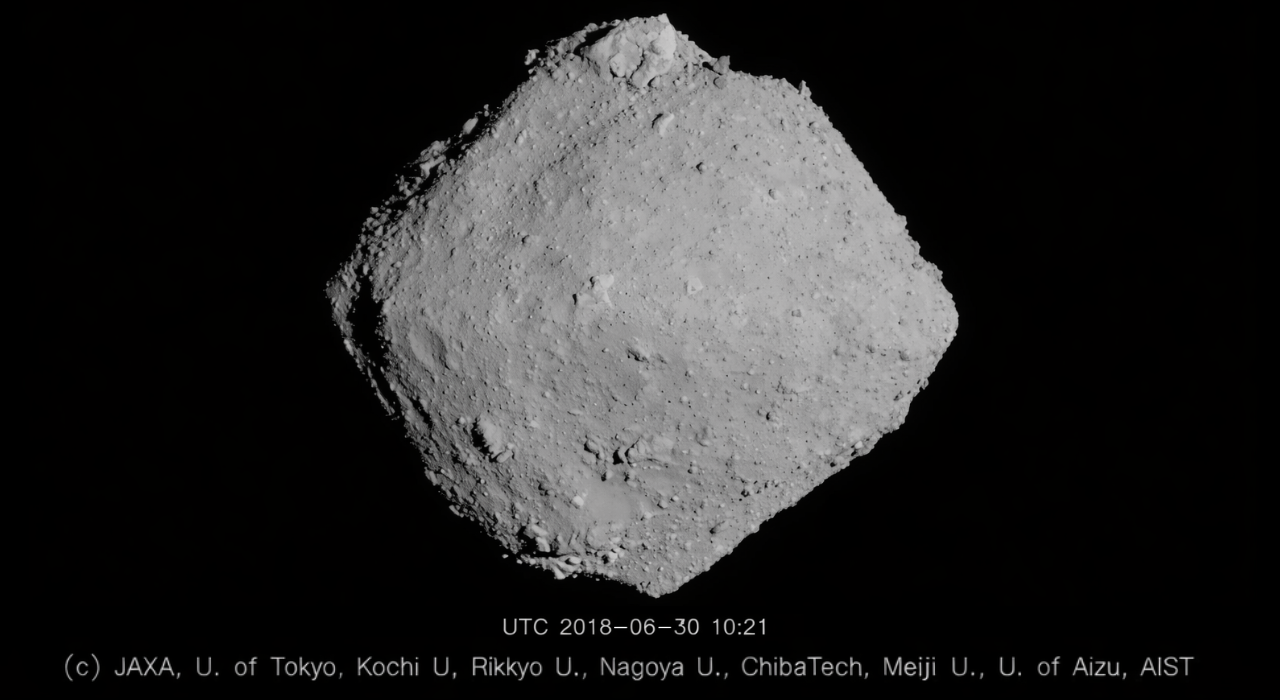
Researchers detected the building blocks of DNA in samples collected from asteroid Ryugu, pictured here. (Image credit: JAXA, University of Tokyo, Kochi University, Rikkyo University, Nagoya University, Chiba Institute of Technology, Meiji University, Aizu University and AIST.)
In simple terms, what scientists have found is not life itself, but an entire chemical toolkit on which life as we know it depends.These molecules, when combined with sugars such as ribose and phosphate groups, form DNA and RNA, the systems that store and transmit genetic information in every known organism on Earth.
How samples were collected and analyzed
The material analyzed in the study came from the Hayabusa2 mission, launched in 2014. The spacecraft reached Ryugu in 2018, touched down on its surface in 2019, and collected samples before returning to Earth in 2020.In total, the mission brought back 5.4 grams of material, an amount smaller than a coin, but scientifically invaluable because it has remained largely unchanged since the early Solar System about 4.5 billion years ago.Earlier studies of a small portion of this material had identified only one nucleobase, uracil, along with the 15 amino acids that are the building blocks of proteins.
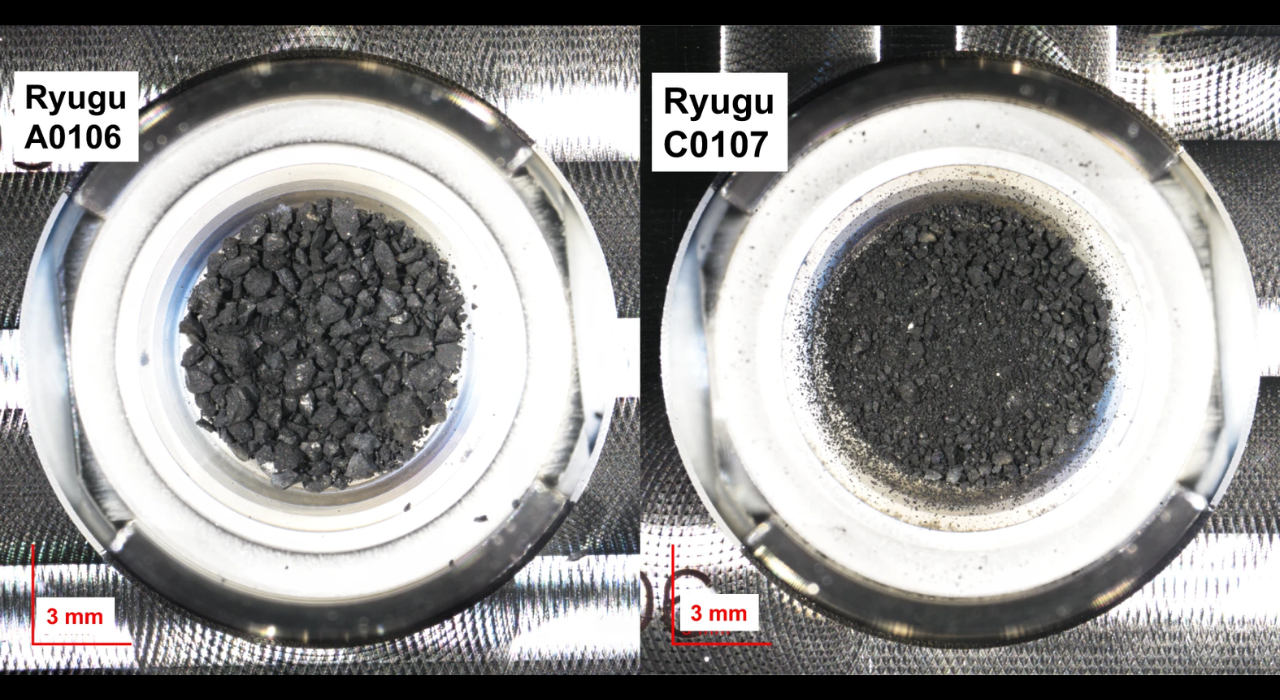
Photographs of initial samples A0106 (total 38.4 mg)6 and C0107 (total 37.5 mg)6 from asteroid Ryugu (162173) during the first touchdown sampling and second touchdown sampling, respectively. Credit: JAXA/JAMSTEC
For this latest research, scientists were given a larger sample, about 20 milligrams of asteroid dust, and used more sophisticated analytical techniques specifically to search for nucleobases. That expanded scope allowed them to detect the remaining four: adenine, guanine, cytosine, and thymine.The researchers also examined how these molecules were distributed, comparing Ryugu’s chemical profile to other extraterrestrial samples, including the asteroid Bennu and meteorites such as Murchison and Orguil, sampled by NASA’s OSIRIS-REx mission.
A chemical pattern that surprised researchers
Nucleobases fall into two structural groups: purines (adenine and guanine), which have a double-ring structure, and pyrimidines (cytosine, thymine, and uracil), which have a single-ring structure.On Ryugu, scientists found a balanced ratio between these two groups, unlike other samples. High concentrations of pyrimidines were observed in the Bennu and Orguil meteorites, while the Murchison meteorite had higher concentrations of purines.
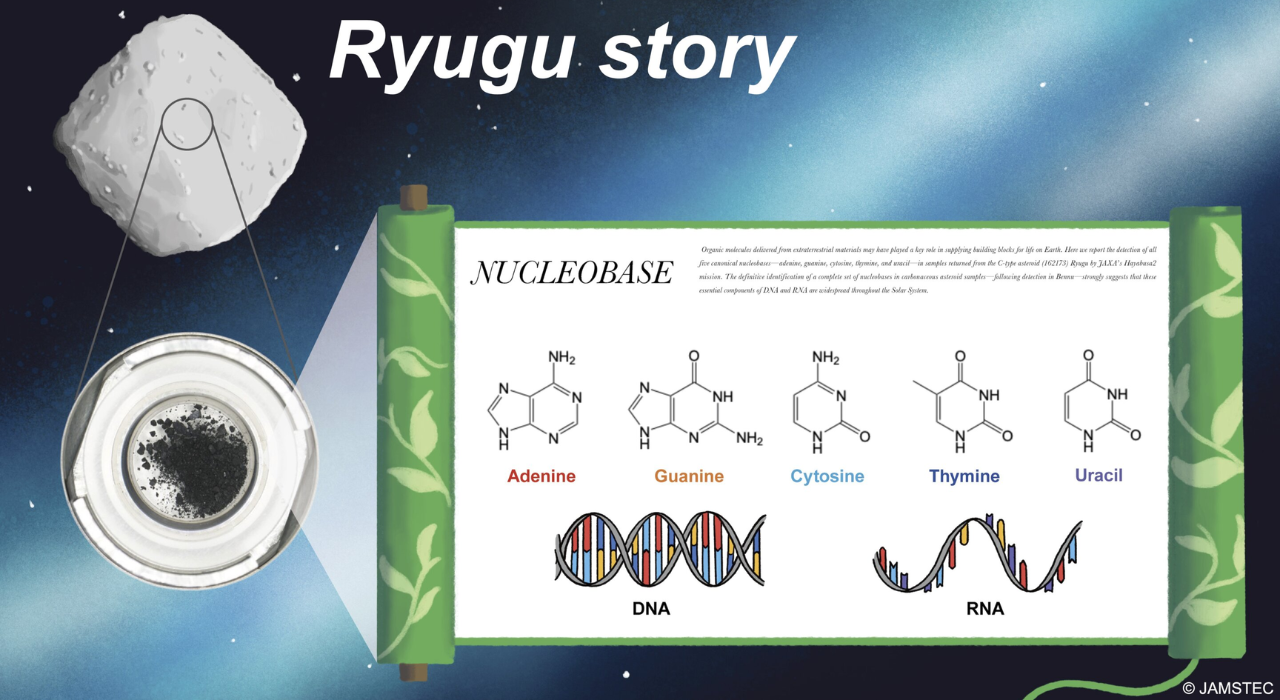

The “Ryugu Story” illustration shows the detection of all five canonical nucleobases in samples returned from asteroid Ryugu by the Hayabusa2 mission. Credit: Jamstech
However, what stood out most was a consistent relationship between these ratios and the presence of ammonia, another molecule relevant to prebiotic chemistry.Koga explained the significance of this pattern in the study, saying:“Because no known formation mechanism predicts such a relationship, this discovery may point to a previously unrecognized pathway for nucleobase formation in early Solar System material.”This suggests that the chemical environment in which these asteroids formed, particularly the availability of ammonia, may have shaped how life-sustaining molecules evolved long before Earth-like planets existed.
What does it say about the origin of life
The discovery sheds light on a long-standing scientific question: Did life begin on Earth, or were its elements introduced from space?Some theories argue that life originated in deep-sea environments such as hydrothermal vents. Others propose that key organic molecules arrived via comets, asteroids, or meteorites, seeding the chemistry necessary for the emergence of life on early Earth.Cesar Menor Salván, an astronomer at the University of Alcalá who was not involved in the study, emphasized that the findings do not prove that life began in space. Speaking to AFP, he said the results “do not suggest that life originated in space.”However, he said that when considered alongside the Bennu findings, the data paint a clearer picture of what is possible:“From this and the results from Bennu, we have a clearer idea of what organic matter might have formed under prebiotic conditions elsewhere in the universe.”In other words, even if life did not originate on asteroids, the materials needed for its formation appear to be naturally occurring and widespread.
A widespread pattern throughout the solar system
This is not an isolated discovery. The same set of nucleobases was identified in samples from Bennu in 2023, and similar molecules have also been found in meteorites that have fallen to Earth.Ryugu and Bennu are both carbonaceous asteroids, a class that makes up about 75% of the asteroids in the Solar System and are known to be rich in organic materials. Observations from the James Webb Space Telescope suggest that they may also share a common origin, having separated from a larger parent body billions of years ago.Because these objects are remnants of the earliest stages of planetary formation, they effectively act as time capsules, preserving the chemistry that existed before Earth’s full formation.As the researchers write in their study: “The detection of diverse nucleobases in asteroid and meteorite material demonstrates their widespread presence throughout the Solar System and reinforces the hypothesis that carbonaceous asteroids contributed to the prebiotic chemical inventory of the early Earth.”
what comes next
For scientists, the next step is not just to confirm the presence of these molecules, but to understand how they form, evolve, and survive in space.Koga said the team aims to pursue that question further:“We want to further elucidate the mechanisms by which the nucleobases essential for life are formed in space and how they come to exist universally.”For now, the implication is clear: The chemistry that underlies life on Earth is not unique to this planet. It may be written into the fabric of the solar system itself, waiting to be transformed into something living under the right conditions.