


Indian engineers are now designing 2nm chips, IT Minister says work is going on to make high-end chips here
Qualcomm is working with its Indian engineering teams on the design of its next generation 2-nanometer chips. IT Minister Ashwini Vaishnav says that India is gradually creating infrastructure to make high-end silicon chips in the country.
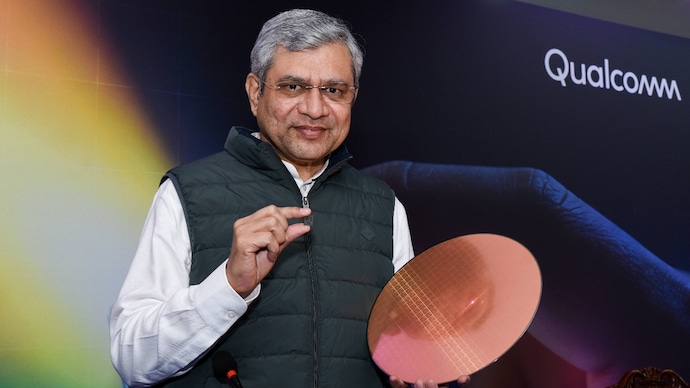

The work of silicon chip design is not new for Indian engineers. But now they are doing it at the top level. On Saturday, Qualcomm highlighted that its India-based engineering teams are directly involved in the design of its 2-nanometer silicon chips. The company confirmed that its Indian teams are developing chips that will be manufactured on the world’s most advanced chip manufacturing technology. Although these chips will be manufactured outside India, their design work has been done here in the country.
The company showcased the ongoing design work on 2-nanometer chips at its Bengaluru facility during the visit of IT Minister Ashwini Vaishnav.
“India is increasingly at the center of how advanced semiconductor technologies are being designed for the future,” Minister Vaishnaw said. “To see Qualcomm’s work here, its engineering strength, deep design capabilities and long-term commitment to India is truly impressive. Milestones like this demonstrate how far India’s design ecosystem has come and strongly aligns with our vision of building a globally competitive semiconductor industry.”
Later at a press conference, the minister reportedly said that this design work at Qualcomm India, puts the country in the league of countries that are at the forefront of chip making capabilities.
“Now from defining the customer product to designing the final silicon, taping it and validating it, it’s all being done here in India,” he was quoted as saying in a news report.
The minister said that India is moving towards increasing its chip making capabilities. “We have very clearly defined the path to 7 nanometers. We have learned from countries like Japan, South Korea and Taiwan how to move from legacy nodes to advanced nodes,” he said.

Qualcomm, one of the leading chip makers of our time and whose processors can be found in millions of phones, is increasingly using its Indian teams for advanced tasks. “India plays a critical role in supporting the design, development and delivery of next-generation technologies for the world today,” said Savi Soni, President, Qualcomm India. “The innovation being developed here is helping shape the future of connectivity, computation and intelligent systems globally.”
While India does not currently manufacture chips at the 2nm node, the government has outlined plans to gradually move towards advanced manufacturing. India’s first manufacturing units are expected to start with mature nodes like 28nm. They are widely used in automotive, industrial and consumer electronics. Officials say plans are already underway to transition to smaller nodes, including 7nm, over time.
Meanwhile, the government is also increasing the scale of semiconductor-specific training in India. During his Bengaluru visit, Vaishnav revealed that around 67,000 engineers have already been trained under SEMICON India Mission 1.0.