


India plans AI-focused data city in Visakhapatnam to attract global investments
India is betting big on artificial intelligence, and a quiet port city on the east coast is being built to fulfill that ambition, with billions of investments, huge data centers and a plan that goes far beyond servers and cables.
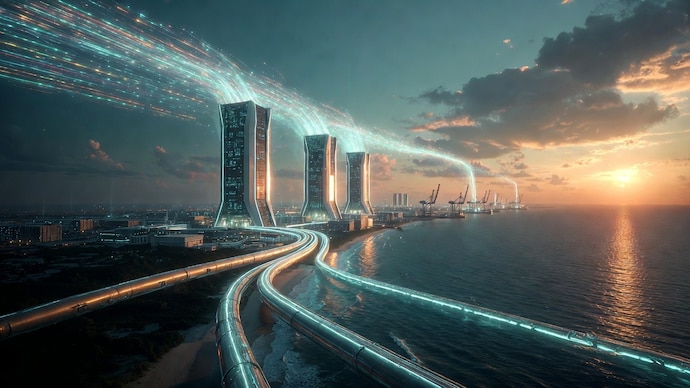

For decades, Visakhapatnam has been living a quiet life on the east coast of India. It is a naval city, a port city, better known for hosting international cricket matches than for creating the future of global technology. That is changing now. Andhra Pradesh wants Vizag to sit at the center of India’s artificial intelligence ambitions, and establish a vast new “data city” designed to draw global capital, computing power and influence to the country, AFP reports.
The push comes as India tries to join the AI race dominated by the United States and China. Policymakers know the gap is real. Instead of incremental steps, Andhra Pradesh is making some bold efforts, like building massive infrastructure that forces global technology companies to take notice.
Speaking before an international AI summit in New Delhi, state information technology minister Nara Lokesh said, “The AI revolution is here, there is no second thought about it.” For Lokesh, the debate is no longer on whether India should adopt AI or not, but how fast it can move to make itself indispensable in the global digital economy.
India plans AI-focused data city in Visakhapatnam to attract global investments
The plan focuses on a strong integrated data ecosystem spread over a radius of 100 kilometers around Vizag. The ambition is huge – hyperscale data centres, manufacturing units for servers and cooling systems, and deep connectivity through undersea internet cables connecting India directly to Southeast Asia. Vizag’s coastline is being deployed as a landing point for submarine cables connecting the country to Singapore, a move that could drastically improve data speeds and reliability for global companies operating out of India.
Money has started coming. Lokesh says that Andhra Pradesh has signed investment agreements worth $175 billion in more than 700 projects. These include Google’s $15 billion commitment to build its largest AI infrastructure hub outside the US. An investment of $11 billion is being made by a joint venture of Reliance Industries, Brookfield and Digital Realty to develop an AI-centric data center in the city.
To secure those deals, the state is offering incentives that are hard to ignore. Land is being made available to big investors at almost symbolic prices. But Lokesh emphasizes that the strategy is not limited to attracting data centres. “It’s not just about data centers,” he said. “I’m going after the companies that build those servers, air conditioning, water-cooling systems — the whole nine yards.” The idea is to create an industrial cluster that holds more value, jobs and expertise within the state.
The political pedigree behind this plan is hard to ignore. Lokesh Andhra Pradesh Chief Minister N. Chandrababu Naidu, who is credited with turning Hyderabad into a global IT hub in the early 2000s. Both are allies of Prime Minister Narendra Modi, who has made technology-led growth a central theme of his economic agenda.
India’s time may also work in its favor. India now ranks third globally in AI strength, ahead of South Korea and Japan, based on indicators ranging from patents to private investment, according to a ranking by the Stanford University Institute for Human-Centered AI. With over a billion internet users, the country has become too big for global AI firms to ignore.

Big tech companies are responding. Microsoft had announced in December that it would invest $17.5 billion in India’s AI infrastructure, its largest investment in Asia. Chief Executive Satya Nadella called it a long-term bet on India’s digital future.
Still doubt remains. Critics say India lags behind in access to high-end computing chips and that many AI applications in the country are still consumer-focused rather than cutting-edge. Others question how many jobs large data centers actually create after construction is finished. Lokesh dispelled those doubts. “Every industrial revolution has always created more jobs than it displaced,” he said, arguing that countries willing to move quickly reap the greatest rewards.
The practical challenges are enormous. Data centers consume huge amounts of electricity and water. Lokesh says the state has planned for both, including using surplus monsoon water that currently drains into the Bay of Bengal for cooling. “It is a crime that so much water goes into our oceans during the monsoon,” he said. On the energy front, New Delhi has already given in-principle approval for six nuclear power plants in Kovvada, indicating that the Center sees Andhra Pradesh as a long-term data hub.
Lokesh openly cites China as a model – not politically, but economically. He points to Beijing’s ability to lift millions of people out of poverty by rapidly building large industrial clusters. Andhra Pradesh is targeting six gigawatts of data center capacity, of which half has already been signed and the rest is in the pipeline.
“We are on a journey,” Lokesh said. “We will implement these projects at a pace that the country has never seen before.” For Vizag, that journey could mean a transformation from a quiet port city into one of the most important gateways to India’s AI economy.