



How Elle Fanning’s Thea turns Predator: Badlands into a feminist triumph
Hollywood star Elle Fanning’s Thea in ‘Predator: Badlands’ brings a new feminist twist to the male-centric action-sci-fi franchise, proving that brains, strategy and silent power can trump brute force.

Actress Emma Watson once said, “Girls should never be afraid to be smart.” It’s a sentiment that’s echoed in feminist discourse for years, and Elle Fanning’s Thea in ‘Predator: Badlands’ feels like its cinematic embodiment.
The ‘Predator’ franchise has never been short of testosterone: hulking creatures, sweaty prey, and that eternal dance of survival between man and monster. But in this latest installment, amidst all the gunfire and roar, it’s a thin synthetic woman who steals the show. Thea: A “synth” engineered by the Weyland Yutani Corporation, sent to explore alien ecosystems and gather intelligence about life on distant planets. Their mission includes the study of the formidable Kalisk and, naturally, the ever-dominant Yautjas. Yet, against all odds, she ends up being the most human thing in the movie.
From her first frame, Thea commands attention. She also appears trapped, vulnerable, until the deck enters the picture. Outcasted by his own clan, Deck is full of bravery, the kind of arrogance that needs no translation between species. It seems that the man transcends ego, time and galaxy alike. Whether it’s Earth in 2025 or a far-flung planet centuries from now, the tendency to underestimate women remains a universal flaw.
But Thea is smart enough not to let it slip. When Deck is hesitant to help, she acts clever, calling herself a “tool” he can use, boosting his ego so much that he feels he is in control. Classic reverse psychology. He frees her, naturally thinking he is doing her a favor, completely unaware that she has already been in on his plan. Predictably, he then takes her on his mission to hunt down Kalisk and destroy him.
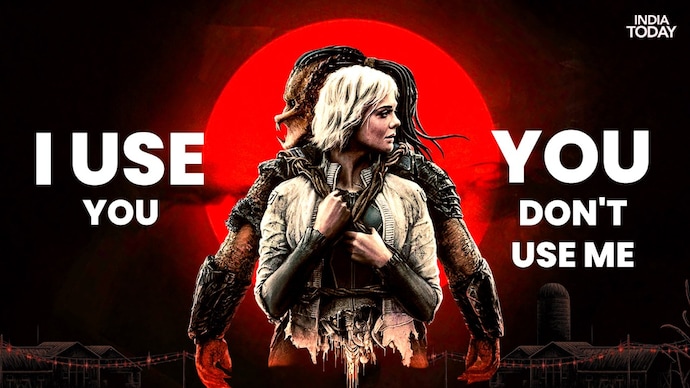
As the story unfolds and the pair’s uneasy alliance deepens, the story takes its most satisfying turn. It turns out that Thea has been pulling the strings all along. She was not a pawn, she was a player. And when Deck finally realizes this, his wounded pride is revealed in the cutting line: “You don’t use me. I use you.”
It’s a moment that lingers because it’s so painfully familiar. That reflexive distrust, that instinctive need to regain control, reflects how society still reacts when confronted with female intelligence and authority. For centuries, women’s cunning has been presented as deceit, their tactics misunderstood as manipulation, their ambition labeled as a threat.

In Thea, Fanning presents a character who subverts that narrative. She fights her battles not with brute strength or grand gestures, but with restraint and intelligence. His power lies in his ability to outthink and outwit, not to prevail. He is not emotionless, nor perfect, and this is his strength.
Fanning’s performance brings a delicate balance to Thea’s contradictions. She is both artificial and extremely real, both a pawn and a queen, a creation as well as a creator. Through her, ‘Predator: Badlands,’ a franchise long defined by primal masculinity, finally allows a woman to dominate not through strength, but through brains.
‘Predator: Badlands’ still has its fair share of explosions and monstrous mayhem, but this time the most dangerous weapon isn’t a laser cannon, it’s a woman with a plan. Thea proves that feminism doesn’t always have to roar in sci-fi; Sometimes all you need to do is smile, stay three steps ahead, and let everyone else move on.