





Hey Ram! Computers and phones are about to get more expensive due to AI rush
The world needs more computing due to the ever-increasing demands of AI. The latest supply shortage is that of RAM. With AI companies buying more and more RAM, the supply is decreasing and leading to higher prices for computers and phones.

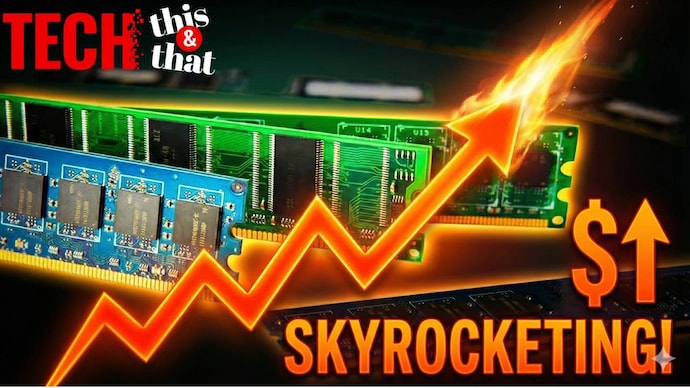


Ask any AI veteran what they want and the answer will be the same. They need more calculations. From OpenAI’s Sam Altman to XAI’s Elon Musk, they all want more compute. And by compute they mean more processing power to deal with the demands of their more powerful and larger AI systems. This processing power comes from various computer components, one of which is random access memory (RAM), which is now in short supply. The result will be that computers and phones will soon be hit and prices will increase.
RAM prices have increased significantly in the last few months. Demand is so high, and AI companies are willing to pay a hefty price for it, that Micron – one of the three largest companies in the field – announced last week that it would no longer sell RAM directly to consumers. Instead, it will only sell it to companies.
“AI-driven growth in the data center is driving demand for memory and storage,” said Sumit Sadana, business leader at Micron. “Micron has made the difficult decision to exit an important consumer business to improve supply and support for our large, strategic customers.”
All supplies for AI companies
Micron is not alone in its “strategic” pivot. Samsung and SK Hynix, two other major players, are equally eager to serve AI companies, which are currently flush with money and willing to pay for chips in gold. Recently there was a report, which was later denied by Samsung, that the Korean company’s RAM division had refused to supply to the phone division and this would affect the upcoming Galaxy S26.
We don’t usually give it much thought because we access AI systems like ChatGPT and Google Gemini through a web browser. But behind the window that we open on an AI app or Chrome, there is a vast AI infrastructure. This is hidden from consumers but without it ChatGPT will not respond to your poor joke with flattering words. Every time you ask AI to do something, this digital genie uses multiple graphics processors and gigabit RAM to give you what you need. Because everything related to AI is extremely demanding, which is why you can only run very small AI models on a computer or phone locally, there is a huge rush for components.
In the past we have seen this demand take a heavy toll on graphics processors. Nvidia, which until 2015 was primarily a company serving video gamers, is now an AI infrastructure provider. The gaming business is now a small part of the company. AMD is in the process of undergoing the same change. Fabs like TSMC are making more AI processors, which go to AI companies like Google and OpenAI, than the processors in your phone and computer.
Now, this congestion is impacting the RAM which is one of the critical components of the AI system. And not only important but AI requires a huge amount of it for both training and inference, which is the real AI use. If your laptop can fly with 16GB or 32GB of RAM, an AI machine – and it has thousands of them daisy-chained together – can have 4 to 6 terabytes of total RAM.
Prices have already increased
This demand for RAM has resulted in a rapid increase in price. Prices of all types of RAM this year have increased between 3X to 6X compared to early 2025. An industry estimate indicates that the RAM in the Galaxy S25 would cost around $35 by early 2025. The same price would now be around $70.
The latest market research indicates that prices are likely to rise similarly into 2026.
In markets like Nehru Place, where people who assemble computers go to buy components, the impact is already visible. Decent 16GB RAM kits now cost over Rs 10,000. The impact on the prices of laptops and mobile phones is clearly visible.


Take a look at the prices of high-end phones recently launched in India. Almost all of them are reaching above Rs 70,000, whereas last year they were between Rs 50,000 and Rs 60,000. More importantly, given the nature of the industry where supply deals are already finalized, we are yet to see the full impact of rising RAM. This will be more evident in 2026 when laptop and phone companies will either have to scale back their RAM ambitions or increase prices significantly.
RAM, whether you care about it or not, is one of the key components of anything with computing functionality. This is where computers keep their data while they are actively processing it. It is part of general computing architecture. For example, when a phone company says its device has 16GB of RAM, it is talking about general computing architecture. But top-quality and very high-performance RAM is also built into other chips, such as Snapdragon or Dimensity chips. It can be L1, L2, L3 cache. Similarly, the graphics processor has its own dedicated RAM.
The increase in the price of RAM and reduction in its supply is going to affect all of them. Worse, given how the component industry works, there may not be any relief coming any time soon. There is no coordination between demand and supply. There is always a gap of a few years between these two. But even if there was no gap, it probably wouldn’t help. Currently AI companies are so hungry for RAM that they will buy infinite quantities of it if suppliers could produce so much. The rest of the world can tighten its belts.
