





Guide: A Timeless Dance of Destiny, Redemption and Love
As part of our retro reviews series we revisit Vijay Anand’s guide. One of the greatest Indian films, ‘The Guide’ is a masterful blend of captivating performances, evocative music and innovative storytelling to trace the transformative journey of two souls amid the dictates of art, love and destiny.

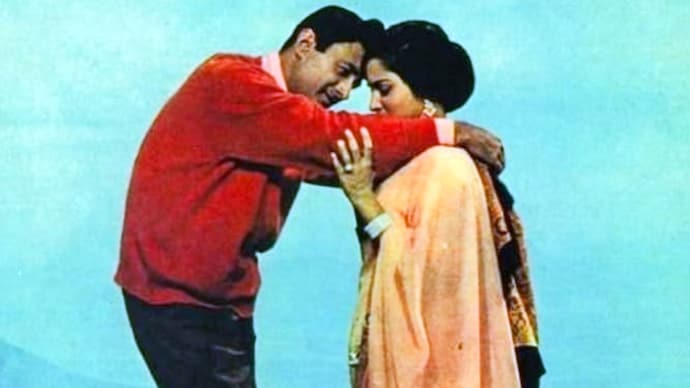


Review: Guide (1965)
Starring: Dev Anand, Waheeda Rehman, Leela Chitnis, Kishore Sahu
Director: Vijay Anand
Music/Song: SD Burman/Shailendra
Where to watch: youtube
moral of the story: Sometimes the greatest act of love is to see the change in another and have the courage to step aside.
There’s an early moment in Vijay Anand’s ‘Guide’ in which the entire film exists in miniature. Rosie (Waheeda Rehman) travels to a colony of Kalbelis (snake charmers), and as the pungi hisses along with the dust, she begins to dance.
Following the slow, catchy sound of the music, his body begins to move tentatively at first. Then the dance takes him away – he claims. The shaking becomes more fluid and then furious, as if months of silent anger are surging from his limbs. Every turn, every stamp of his foot becomes a rebellion. Her saree, flaring and clinging, forms a storm around her.
Rosie dances, stumbles – almost exhausted – steadies herself and starts spinning again. After becoming unconscious, Rosie comes out of trance only when someone sprinkles water on her forehead.
Vijay Anand breaks the moment with a quick cut: his feet, the crowd gathered, Raju (Dev Anand) watching from the periphery. The snakes flutter in the woven baskets, reflecting some deep rhythm only he and Rosie seem to hear. The editing itself becomes a kind of dance, matching the rhythm of folk music, creating a feeling of breaking and liberation.
This scene is essential because it highlights the film’s central tragedy: Rosie’s art is her escape, her claim to selfhood in a world that wants to reduce her to decoration. And Raju? He is merely an instrument of destiny, a witness who is present when she is ready to be freed.
The hero as an instrument of destiny
What makes this scene so devastating is how it foreshadows the main conflict of the film. Raju believes that he is shaping Rosie’s destiny – discovering her talent, managing her career, turning her into a star. But the Sapera scene reveals the truth: his artistic awakening is entirely his own. She doesn’t need to tell Raju who she is; She needs someone who won’t stand in her way. By the time Raju understands this, turmoil begins in his life.
The climax of the film mirrors that early snake charmer scene with brutal accuracy. Just as Rosie danced for the innocent audience, Raju plays a different role for the desperate villagers – the holy man, the fasting saint who will bring rain. Both are performances, but where Rosie’s dance was authentic self-expression, Raju’s fast is something else entirely: penance, trap, perhaps the only honest thing he has ever done.
Once again, Raju is not the master of destiny but its instrument. He does not choose to be the protector of the villagers; Misunderstanding and circumstance imposed this role on him. The crowd gathers – just as they did for Rosie’s dance – but now they are pinning their desperate hopes on her. One who once tried to take possession of another’s destiny is ultimately completely taken over by forces beyond his control.
In one of the early scenes, a villager asks Raju where he is going. He replies, I have realized that it is best to surrender to destiny. The entire film reflects this succumbing to fate.
price of salvation
The Guide is often celebrated as a progressive film about a woman claiming her artistic identity, and it is just that. Waheeda Rehman’s performance is dazzling, capturing both Rosie’s fragility and her steel core.


But the film is equally interested in what the cost of salvation is for everyone it touches. Rosie regains her freedom, but at the cost of social ostracism and scandal. Raju’s attempt to become a savior destroys him – not dramatically, but through the slow accumulation of compromises, lies and the inevitable clash between his desires and hers.
SD Burman’s music, especially the unforgettable ‘Aaj Phir Jeene Ki Tamanna Hai’, reflects this duality – songs of hope laced with sadness, liberation laced with loss and loneliness. Burman’s music between ‘Aaj Phir Jeene Ki Tamanna’ and ‘Yahan Kaun Hai Tera’ makes this journey immortal.
Vijay Anand’s visual language
The home of the Anands – Chetan, Dev and Vijay – was one of India’s greatest creative engines. Apart from the three brothers and their Navketan Studio, it also deserves credit for fueling the creative journeys of Guru Dutt, Raj Khosla and Kishore Kumar. (In his early years as a playback singer, Kishore lent his voice only to Dev Anand, starting with ‘Ziddi’).
Vijay Anand was one of Hindi cinema’s most innovative visual storytellers, and ‘Guide’ reflects his mastery. The rapid cutting to the snake charmer scene – very bold for 1965 Bollywood – creates a fragmented, almost intoxicated consciousness. We experience Rosie’s ecstasy not through classical long takes, but through fast cuts and close shots: hands, faces, snakes, instruments, movement.
This editing style is repeated throughout the film, creating a modern kinetic energy that sets ‘The Guide’ apart from its contemporaries. Within the first 40 minutes, Vijay Anand has captured Raju’s transformation from guide to criminal and from criminal to saint. Within the same time frame, Rosie’s character also progresses rapidly – from a Devadasi’s house to her bride’s mansion, and eventually to the world of the stage. Vijay Anand was among the few who understood that the way you cut can be as expressive as the way you shoot. His influence on later Indian cinema cannot be underestimated.
a film that lasts
‘The Guide’, based on the novel by RK Narayan, is a timeless classic because it refuses easy answers. It does not condemn Raju or tarnish Rosie. Instead, it looks with remarkable clarity at how people use each other in the name of love, how good intentions come to take over, how we are all agents and instruments of forces larger than ourselves.
The snake charmer scene gets it right from the start: that moment when Waheeda Rehman surrenders to the rhythm, when the cuts come faster and faster, when Dev Anand watches from the sidelines – that’s the entire film. Art as escape. Love as complexity. And the terrible, beautiful truth is that sometimes the most we can do for another person is watch their change and then step aside.