





Gramayan review: Vinay Rajkumar’s rural drama is honest, but lacks impact
Gramayan Movie Review: Directed by Devanuru Chandru, the rural drama starring Vinay Rajkumar, Megha Shetty and Gopalkrishna Deshpande impresses in parts but fails to leave a lasting impact.

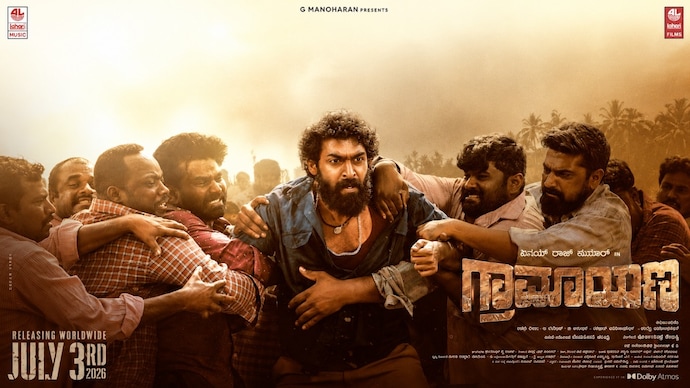


2026 was not good for Kannada cinema. Half a year has passed, and the industry is still waiting for its first clean hit. At a time when Kannada audiences are eager for quality cinema, gramayanStarring Vinay Rajkumar, comes with the weight of those expectations. Can it benefit both the industry and its audience? Let’s find out.
gramayan Comes with a clear set of powers. The story, performance and technical departments are particularly noteworthy. The emotional moments, charming romance and serious expanse of action and drama keep the film interesting throughout. Yet, despite all its strengths, the film fails to reach its true potential due to inconsistent execution.
❮❯
It’s disappointing when a movie is a complete dud, but when a movie shows real promise in several departments and still lets you down, the disappointment is much greater.
Devanuru Chandru has written a story based in rural Karnataka in the mid-2000s. The story revolves around the difficulties of a village and the various human tendencies emerging in it. Seena (Vinay Rajkumar) is an ordinary village boy who aspires to become something meaningful in life, but lacks direction and spends most of his time doing odd jobs with his friends. Kusuma (Megha Shetty) is a degree student who also helps her father in farming. She is fierce, resilient and unbreakable.
Kaari Bekku (Yogesh) is the village cable TV operator, a volatile man willing to cross any limits when it comes to protecting what he owns, often clashing with Seena and his gang. Joining him are Gopalkrishna Deshpande as a manipulative politician, Achyut Kumar as the village doctor, Jahangir as the village journalist and many others. Through these characters, Chandru creates a rural drama that comments on politics, human nature and the struggle of the Dalits.

The story puts a lot of emphasis on the love between Seena and Kusuma. It highlights the value of friendship in the village, especially when Seena and his friends are willing to go to any extent to arrange the marriage of their dead friend’s sister. The film also examines how politicians exploit and betray innocent, uneducated farmers, the helplessness felt by educated individuals trapped in such systems, and the power of the Right to Information (RTI) Act.
An impactful dialogue says, “A person who gives his vote for money does not have the right to use RTI”, and with this the film also highlights the irresponsibility of the people. Through such moments, the film highlights many important issues while offering engaging visuals and compelling drama.
However, Devanuru Chandru struggles to give these themes the impact they deserve. The script suffers from serious issues. The writer-director introduces many interesting ideas and conflicts but rarely resolves them in a satisfying way. The film rarely takes the time to properly build its drama, often rushing through explanations before moving on to the next issue. This creates the feeling that several key scenes are missing, which ultimately contributes to an underwhelming experience.
Although the story revolves around itself in the first half, it still succeeds in generating intrigue and ends on a strong pre-interval note. The film successfully establishes romance, rivalry and political drama right from the start. However, the second half loses focus and goes off on several tangents, which becomes confusing at times.
These twists might have worked if the climax had delivered a stronger payoff, but after all the stakes and questions raised, the solution, like the final sequence involving sheep being crushed by a train in the film, is just “meh.”
Gopalkrishna Deshpande once again performed brilliantly. Megha Shetty is equally impressive. Although she looks beautiful on screen, it is her commanding presence and strong performance that really stands out. Vinay Rajkumar has also shown remarkable growth as an actor, giving a grounded and honest performance. Rooted stories that demand restrained acting seem best suited for him.
Although these three characters get the strongest material, the same can’t be said for everyone else. Especially Yogesh and Achyut Kumar feel underutilized. Yogesh’s character gradually loses his edge and turns from a potentially compelling opponent into a regular goon. Achyut Kumar, despite being such a capable actor, is seen dispensing wisdom at times without making any significant impact on the story.
Similarly, many supporting characters are given enough attention to be interesting but not enough development to make their ultimate actions or fates emotionally effective. The best way to describe many of these characters is “undercooked”.
However, technically the film is excellent. Cinematographer Santosh Rai Pathaje deserves the highest praise, with art director Shiv Kumar equally deserving of praise. Purnachander Tejaswi SV’s music complements the film well, and the songs leave an impact, although popular Benki The track probably would have worked better as a promotional number rather than solely as a narrative. Editor Deepu S Kumar also does a respectable job in trying to iron out the script’s inconsistencies as much as possible.
overall, gramayan Joins the growing list of Kannada films with strong potential but underwhelming execution. It still serves as a nice one-time watch. The disappointing thing, however, is that it clearly had the ingredients to be an impressive rural drama capable of leaving a lasting impression.