



Government-backed Bharat Taxi adds 45,000 users per day, teaser of big nationwide launch released
Government-backed Bharat Taxi is seeing a fast start, adding 45,000 users daily as it prepares for a large-scale launch across the country.
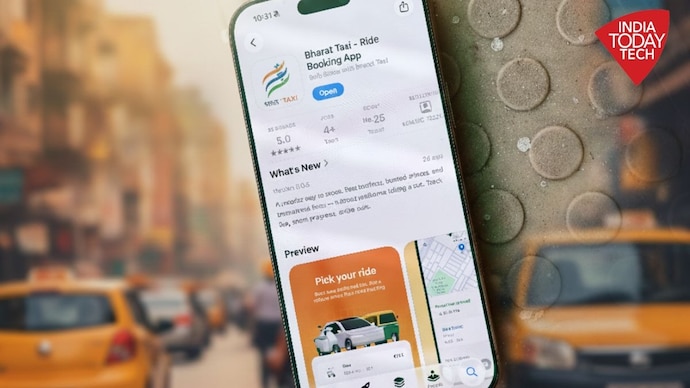

A new government-backed cab-hailing app has been quietly gaining momentum across India. Bharat Taxi, backed by the Ministry of Cooperation, has seen a sharp surge in user interest just days after going live, with thousands of new registrations happening daily. The platform is now available on both Android and iOS, and our experience shows that it is already making its presence felt among the popular ride-hailing apps.
Bharat Taxi adds 45,000 users daily
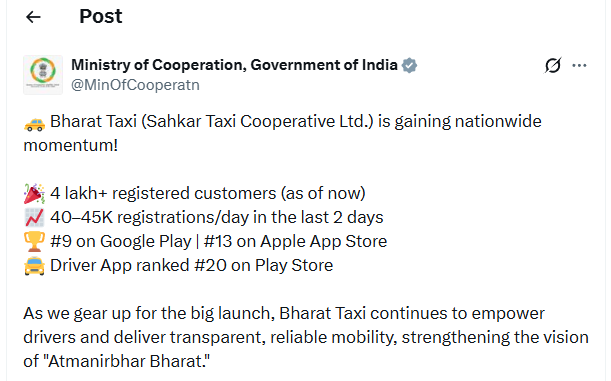
This momentum was highlighted by the official X handle of the Ministry of Cooperation, Government of India. The ministry said in its post that Bharat Taxi has crossed four lakh registered customers so far and about 40,000 to 45,000 users are being added every day in the last two days. The app is currently ranked ninth on Google Play Store and thirteenth on Apple’s App Store, while the driver-focused app is ranked 20th on Play Store. The ministry described this phase as a larger nationwide rollout, with Bharat Taxi being introduced as part of Union Home and Cooperation Minister Amit Shah’s broader “self-reliant India” and “co-operation to prosperity” vision.
Bharat Taxi: Features, Safety, Setup Process, Practical Experience and more
Bharat Taxi was formally introduced by Amit Shah as a new cooperative-based, government-backed alternative to the crowded cab aggregator sector. The app claims to offer police-verified drivers and a transparent approach to mobility, with an emphasis on empowering drivers. From a user perspective, the interface is clean and easy to navigate. Booking cabs for city trips is easy, and the app also features options beyond rides, including metro ticket booking and a rental feature that allows booking up to 12 hours ahead.
There is also a push and pull regarding security. App banners show emergency features like calling the police, alerting saved contacts, reaching out to the security team, and sounding the siren from within the app. Some of them are familiar ideas to users of platforms like Uber, which already allow riders to share live trip details with contacts. Whether Bharat Taxi’s safety devices work reliably in real-world conditions is something that will only become clear with wider use.
That said, early hands-on use does introduce some rough edges. For example, pricing does not always seem as competitive as one might expect from a government-backed service. In some cases, fares appeared slightly higher, and there were discrepancies like the same price being shown for both AC and non-AC cabs, pointing to a possible bug in the app. While the login process is dead simple, requiring only a mobile number, name, and email address, the overall experience still feels like a work in progress rather than a polished final product. In my case, it took less than a minute to set up the app and create a profile.

The biggest promise of Bharat Taxi is how it treats its drivers. The platform is promising not to take any commission from drivers initially, meaning the entire fare paid by passengers will go directly to them. But, a report in ET Now indicates that it may levy up to 20 per cent later, but claims that this too will be distributed back to the drivers in some form or the other. There are also plans to set up dedicated pickup and drop points at airports, similar to Ola and Uber, with the possibility of expanding this model to other major transport hubs.
For now, its success will depend on implementation – how well demand and supply are balanced, how consistently competitive prices remain, and whether the app meets its claims of security and reliability at scale.
With the number of users growing rapidly and the announcement of a full-scale national launch, Bharat Taxi is off to a promising start. The coming weeks should reveal whether this cooperative-driven model can truly challenge the established players or whether it remains a well-intentioned experiment in India’s rapidly growing mobility market.