


Google is spending $15 billion to build AI in India, plans US-India undersea cable link
At the India AI Impact Summit, Google has announced that it will connect India to the US through new sub-sea cables as part of a $15 billion investment over five years. This will promote AI connectivity between the two countries. Along with this, the company plans to expand data centers and cloud capacity, as well as launch AI skills programs and other related initiatives.

Google has announced some big AI-led initiatives for India. A highlight of this $15 billion five-year investment is the construction of new undersea cable routes connecting India to multiple global destinations to support the expansion of AI infrastructure in the country. The sub-sea fiber expansion is part of Google’s US-India Connect initiative and broader AI infrastructure commitment in India.
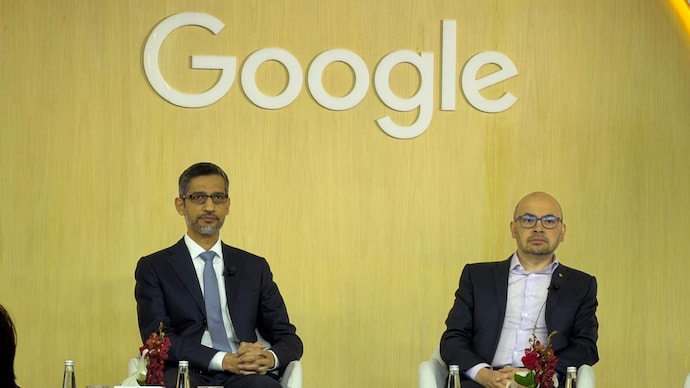
Speaking at a Google event in Delhi, CEO Sundar Pichai said the company is launching the India-US Connect initiative, under which it will build new sub-sea cable routes to enhance AI connectivity between India and the US.
“Today, we are announcing the India-US Connect initiative, which will provide new subsea cable routes to enhance AI connectivity between India and the US and multiple locations in the Southern Hemisphere,” Pichai said. “To capitalize on the opportunities this initiative creates, we must also invest in skills, which is why we’re here to announce our most ambitious skills programs yet. This includes a new Google AI Professional Certificate program to help people master AI in their work.”
Google will build a sea cable connecting India and America
At the center of Google’s huge AI-based investments in India is its US-India Connect initiative. As part of this project, Google will establish a new international sub-sea landing station in Visakhapatnam off the east coast of India, creating an additional entry point into its global network. From there, three new subsea routes have been planned to connect India to Singapore, South Africa and Australia.
The company will also add four terrestrial fiber routes designed to improve connectivity between India, the United States and locations in the Southern Hemisphere.
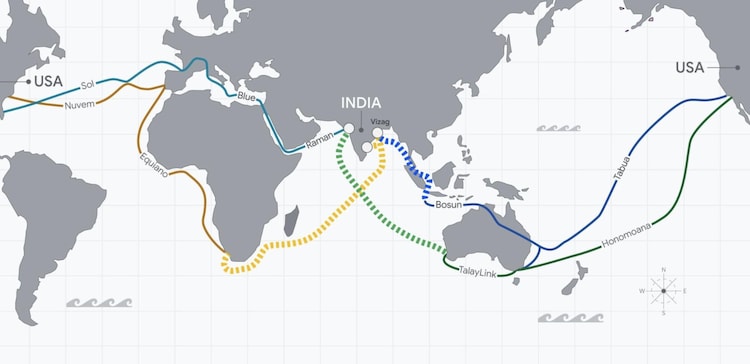
Google says the goal of the undersea cables is to increase network capacity and reduce the risk of outages by diversifying traffic flows between regions. The new infrastructure is expected to support the growing demand for cloud computing and AI services in India, as well as strengthen connections with Africa, Australia and parts of Southeast Asia.
Google will invest 15 billion dollars in India
In addition to undersea cables, the company also plans to build the physical and digital systems needed to support large-scale AI services, including data infrastructure and cloud capacity, as part of the $15 billion investment deal.

As part of the investment, Google will expand data center capacity and cloud infrastructure to support AI model training, deployment and storage. According to the company, the investment is aimed at building long-term core infrastructure rather than short-term product rollouts, supporting AI adoption in both the public and private sectors.
The company has also announced additional programs related to AI adoption and public sector efficiency. These include a $30 million Global AI for Government Innovation Impact Challenge and a $30 million AI for Science Impact Challenge to support the use of AI in public services and scientific research.
Google is also establishing partnerships with Indian government bodies and local institutions to provide access to AI for DeepMind science models and support national research priorities. In collaboration with the Office of the Principal Scientific Adviser to the Government of India, the company is setting up a Google Center for Climate Technology focused on AI-powered climate research.
On the skills front, Google Cloud iGOT is working with Karmayogi Bharat to provide infrastructure for the Karmayogi platform, which supports over 20 million public servants across 800 districts. The partnership includes digitizing legacy training content into searchable resources and enabling content in over 18 Indian languages.