



Ghar Kab Aaoge, the enduring legacy of the Border 2 song that both hurts and heals
Nearly three decades after Border, Sandesh Aate Hain Ghar Kab Aaoge returns, reminding us why one of Hindi cinema’s most enduring patriotic songs still reflects the absence, longing and silent sorrow of soldiers and home.
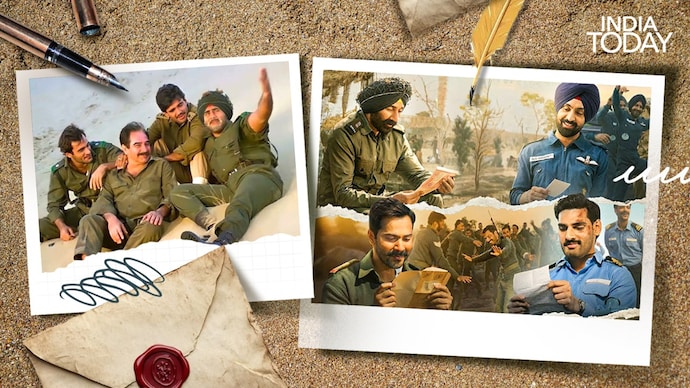

Tanot in Jaisalmer at a symbolic location near the India-Pakistan border, creator of border 2 decided to re-launch one of the most emotionally indelible songs of Hindi cinema. Topic When will you come home In its new avatar, the raga works again Messages come – The song that gave the emotional vocabulary of patriotism to a generation. The number has been reworked with new lyrics and additional voices, and it raises a big, unavoidable question: What is it about this composition that, nearly three decades later, still works, still wounds, still comforts?
The answer perhaps lies in how deeply and beautifully it understands emotions as India’s most powerful cinematic language. When will you come home Not loud, triumphant, or declarative. It is thoughtfully drenched in absence. It suffers from longing and bears the burden of sacrifice without giving it the name of heroism. The song also reflects the emotional reality of soldiers and families separated due to duty – where love for the nation exists alongside the unbearable pain of distance from home.
At its core, this song is a complete emotional experience. The music, originally composed by Anu Malik, moves with restraint, allowing silence and space to do as much work as the melody. The songs, written by Javed Akhtar and Manoj Muntashir Shukla, are very strong but also resist grandiosity. They talk about relationships: “Remember the dolls you played with.“Referring to a little daughter playing with her doll;”I will find a way, don’t torment me“, referring to a wife who promises to wait and keep an eye on the road;”I left behind, mother praying.Referring to a mother whose prayers pursue her son to the limit. These are not abstract ideas about family – these are intimate, recognizable, universal images that transcend generations.
Consider these lines:
“Ask this with tears in your eyes,
No one gets separated easily.
I left behind a praying mother,
That she also loves this mother earth.
Loosely translated, they ask us to listen to the tears of those who know how hard separation really is. They speak of a mother left behind, who prays endlessly, and of a son who loves his mother very much, but chooses the motherland over that love. The song never resolves this tension. It allows it to exist, raw and unresolved. It speaks of sleepless nights, unfulfilled promises, unspoken words – all of which keep asking the same, devastating question: When will you return home?
That’s why the song endures. It does not seep into victory and holds waiting and trust in the highest esteem.
Back in 1997, when Limit Issued, messages arrive It emerged as a defining patriotic song for a generation shaped by volatile geopolitics and an emotional idea of the nation. It became a milestone because it humanized nationalism and continues to do so.
The song also offers hope, though never cheaply. There is an unspoken promise that one day the wait will end – that festivals will be celebrated together, that normal happiness will return. But its greatest power lies in what it prevents: reunion, closure, reassurance. Homecoming isn’t guaranteed, and while most patriotic songs try to anoint that feeling as bravery, this one only honors that truth.
in that sense, When will you come home It is among the most emotionally resonant patriotic works of Hindi cinema. O! my countrymen, It is said that this classic composition of Lata Mangeshkar brought tears to the eyes of Jawaharlal Nehru. Like C. Ramachandra and poet Pradeep’s 1963 song, messages arrive Reshaped how patriotism could be expressed through vulnerability. It marked a change in the late 1990s, when Hindi cinema briefly allowed patriotism to be soft, painful and personal.

new version, When will you come homeEffort to carry forward this legacy. It brings together five voices: Sonu Nigam and Roop Kumar Rathore, who lent their voices to the original, are now joined by Vishal Mishra, Arijit Singh and Diljit Dosanjh, who sing for their characters in the film. The choice of voices themselves seems deliberate: a strong bridge between memory and present, between what the song once meant and what it is expected to mean today.
Visually, the song is anchored by Sunny Deol. Limit Universe, with Varun Dhawan, Ahan Shetty, Paramveer Singh Cheema and others. Directed by Anurag Singh and produced by Nidhi Dutta, daughter of JP Dutta, who directed the original film. border 2 Positions the song as a callback, yes, but also as an emotional legacy.
Hindi cinema has the ability to fully understand that silent sorrow. messages arrive Timelessness still remains an open question. However, what is certain is that songs like this are not made easily or often anymore. It’s easy to find quick anthems and surface-level patriotism, but ‘Sandesh Aaye Hai’ is a reminder of a time when our cinema learned to rely on calmness, restraint and emotional honesty.
The song remains a memory that people remember when words fail – a number that still hurts, and heals at the same time.