





CM-in-waiting: How Vijay supporters turned into a political tsunami?
In Tamil Nadu, Vijay’s victory was the culmination of a decade-long script written in cinema halls. We can discuss Vijay’s victory, but the real thing is how his fans turned faith into political power.

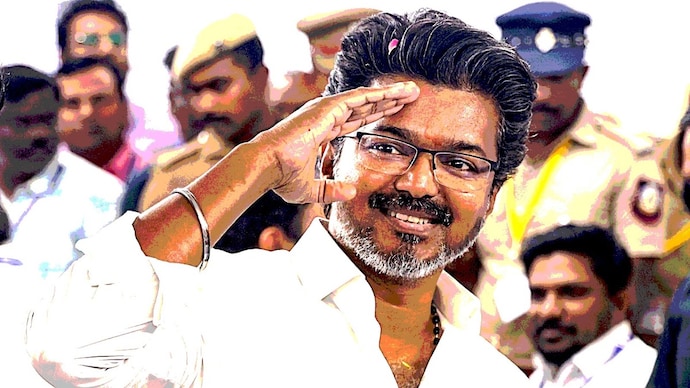


Thalapathy Vijay may seem like a political newbie despite winning his first election with TVK, securing 108 seats out of 234, but those following his journey know that the seeds were sown years ago. Vijay did not enter politics suddenly. He was rehearsing for this in front of everyone.
The big question everyone is asking is wrong. The question is not how Vijay managed to do this, but what kind of power did he use?
❮❯
The answer may seem vague only to those who do not fully understand manpower – the same power that makes a star’s movie tickets sell like hotcakes. In the South, that power, often described as celebrity worship, has existed for decades. What Vijay has done has not only benefited but also led to its revival.
Vijay’s carefully crafted manifesto, his appeal to young voters, promises to women, his social media presence, and the pride he took in being an actor – all worked in his favour. Not because he was mobilizing people to support him, but because they already had him.
If that was the case then he was simply giving his fans a new task. The brief was clear: Just as you come to buy tickets for my films, come and vote for me.
And they did.

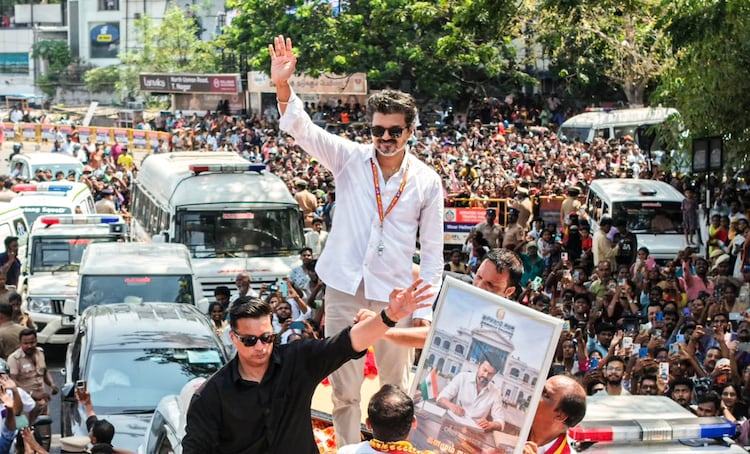
In just two years of its existence, Vijay’s Tamilaga Vetri Kazhagam (TVK) broke the long-standing duopoly of the DMK and AIADMK, bringing about a dramatic change in the political landscape of Tamil Nadu. This is no small achievement. But limiting it only to political strategy will not suffice. Because this victory did not happen in two years. It was built with carefully orchestrated public cooperation over more than a decade. And it’s hard to imagine it without the love of the fans, their madness, their blind faith in Vijay.
Of course, there is a political context to this moment. Voter fatigue, the search for new faces and rising youth voters played their roles. But what set Vijay apart was that he did not enter politics as an outsider seeking acceptance. He entered as someone who was already deeply, emotionally and almost unquestioningly accepted.
This is where the fans blur into something more powerful. On the day of the results, reports emerged that a fan of Vijay attempted suicide by slitting his throat out of fear of his defeat. In another case, a young woman allegedly threatened her parents that she would not return home if they did not vote for her. Or fans were subjecting themselves to torment using fish hooks during processions, as a form of penance in anticipation of Vijay’s victory.
These are extreme reactions but it’s also indicative of how personal fandom can become. The dark side of fans? Yes. But at the same time, there is also that side of the fans that arguably helped Vijay in the 2026 Tamil Nadu Assembly elections.
The dark side of devotion? Yes. But it is also a reflection of the emotional investment that can be mobilized during elections.
Fans were ready to do anything. When the time came, they became fan voters. When it comes to showing love for your favorite star, the platform hardly matters – theater or polling booth.
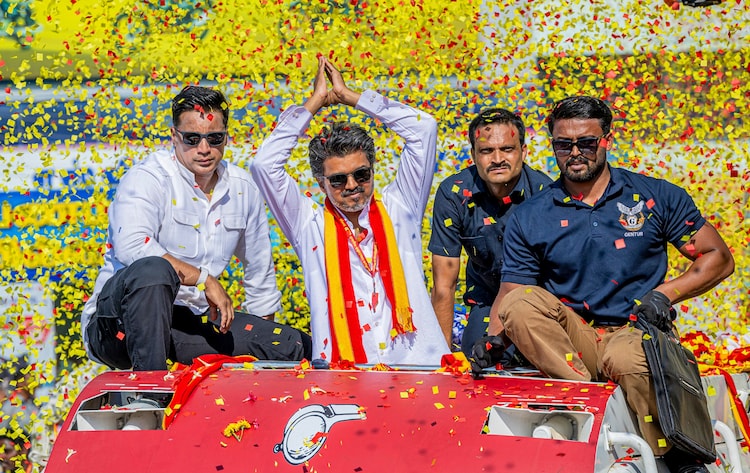
In its early years, when a party was trying to become generally recognized, TVK ran, led and won by all means. The more you look at the celebrity worship culture that fits so seamlessly into Vijay’s case, the more you realize that TVK may have been formed in 2024, but its campaign started much earlier – long before the rallies and road shows – in theaters last decade.

Take any of 51-year-old Vijay’s films of the last decade and you’ll start to see how this triumph was engineered – one film at a time. He was already a leader in the hearts and minds of the people, as the same audience had seen him as a leader on screen for a long time. And over time, that became the only image they remembered, the only image they believed in.


Vijay positioned himself as the ultimate solution to Tamil Nadu’s problems in his films. We often say that cinema reflects reality, but here, reality seems to be shaped through cinema. In kathy (2014), Mersal (2017), Government (2018), Bigil (2019), Owner (2021) and leo (2023), Vijay was the savior – a leader people could trust, a ruler who could fix anything, a king who stood up for the welfare of his people.
We often say that cinema is a mirror of reality. In Vijay’s case, cinema not only reflected reality but also shaped it. The audience appreciated, remembered and celebrated Vijay’s on-screen personality. Over time, the line between the on-screen leader and the real-life person blurred. The audience began to believe that he could lead.
This is where he possibly stopped being just an actor and became an authority – someone seen as aware of the issues and capable of fixing them. When it came to politics, the same audience did not hesitate in increasing that love. The celebration just moved from the screen to real life.
Tamil Nadu has seen this before. From MG Ramachandran to J Jayalalitha, the journey from screen till now Speculative Not new. But what Vijay represents is a more evolved version of that template, driven not just by fan clubs, but by digital virality, meme culture and constant online visibility.
It’s a fan in the age of AI. This is unquestionable loyalty.
And yet, to say that this win is only about the number of fans would be too simplistic. Politics is never one-dimensional. There were times, there was a leadership vacuum, and there was a generation that was ready to believe in something or someone new. Vijay activated all this, with one emotion.
He transformed admiration into trust and that trust into recognition. And when someone does that, democracy looks very different. While it basically remains a competition of ideas, it also starts to feel like a coronation.
Besides, what is a blockbuster if the hero isn’t the one who wins?