China’s Kimi K2.5 AI challenges the best from Google, Anthropic and OpenAI despite its open source approach
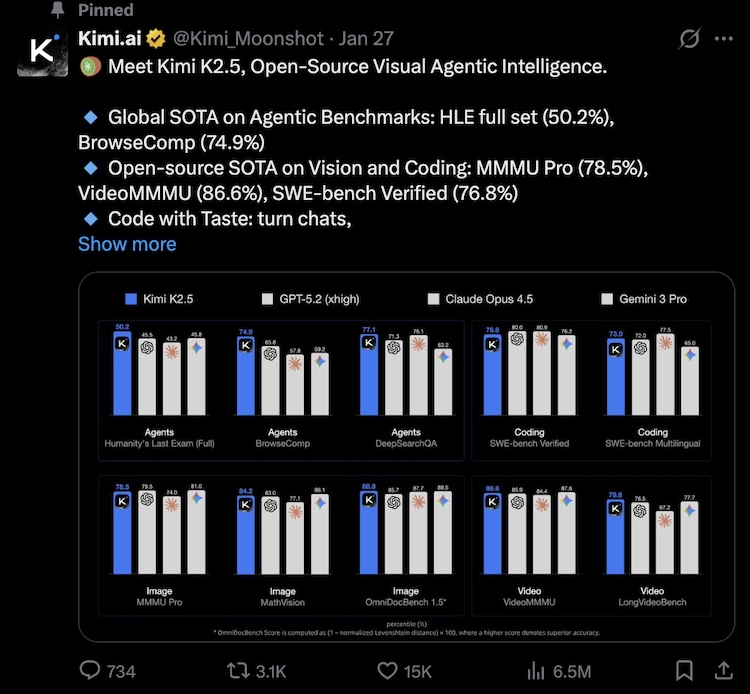
There is a race going on between American and Chinese AI companies. The latest model to join the competition is the Kimi K2.5 AI, which is so good that it is matching or beating American AI models like ChatGPT, Cloud, and Google Gemini.
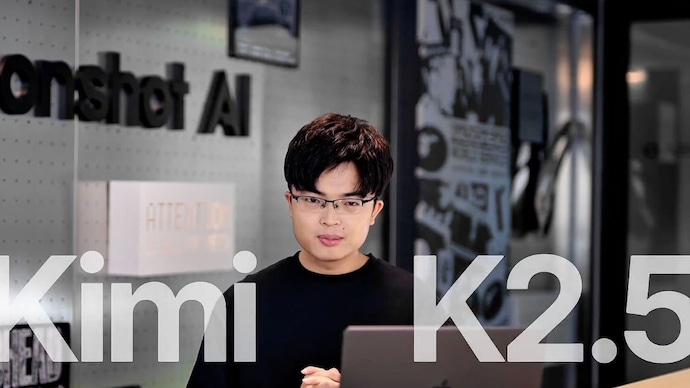

There is a competition going on between Chinese and American companies in the world of AI. But both are using different methods. While American companies are pushing top but paid and expensive AI models like the latest Gemini and Cloud, Chinese companies are offering almost equally good but cheaper and open-source models. And these open-source models, given how good they are, could spoil the game for American companies. The latest on the list is the Kimi K2.5 model, released by Moonshot AI. It’s matching or beating the best pushed out by American companies.
The Kimi K2.5 is also said to be the company’s first model that combines robust logic, coding, and multimodal capabilities into a single open-source system. The launch of Kimi K2.5 comes at a time when Chinese AI developers are stepping up efforts to compete and win the AI race against US giants like OpenAI, Google DeepMind and Anthropic, which currently lead the field with systems like ChatGPIT, Gemini and Cloud.
What is KM K2.5?
Although there are a lot of technical details, it is important to note that the Kimi K2.5 is an AI model that appears to be as good as the latest Cloud, ChatGPIT and Google Gemini. It also has agentic features, which means it can work independently, as well as an agent swarm feature where it can control multiple AI agents on its own.
One of the most notable upgrades of the Kimi K2.5 is its versatility. Unlike earlier open-source models, which focused primarily on text, K2.5 can natively process and generate text, images, and video. Powered by Moonshot’s in-house vision system, MoonVIT, the model can analyze screenshots, understand video demonstrations and even attempt to recreate apps or websites based on visual input.
Moonshot refers to this capability as “coding with vision”, pitching it as a more intuitive way to create software, especially for developers who prefer vibe coding and are working from design mock-ups or screen recordings rather than detailed written specifications.
AI systems have certainly impressed many people in Silicon Valley. “Moonshot’s KM K2.5 is the new leading open weight model, now closer than ever – with only OpenAI, Anthropic and Google models,” wrote a user on Twitter, X alias.
Open source AI could spoil the party
The real significance of Chinese models like the K2.5 is not that they are good. This is because they are available as open-source AI models. Although they are still expensive to use relative to what Anthropic, Google or OpenAI are charging for their AI models, as we saw last year, the K2.5 and DeepSeek R1 are incredibly cheap. Overall and for top level work, they are not as good as the top US AI models, but they are good enough and quite cheap.
This is hurting American tech companies as they try to get the rest of the world to subscribe to their expensive AI plans.
Perhaps there is a method to the Chinese madness. For example, Moonshot has chosen to release the Kimi K2.5 as an open-source model, making its weight publicly available and allowing commercial use. The company highlights that developers can run the model locally, fine-tune it on private datasets, or access it through Moonshot’s API at a fraction of the cost of comparable US models.
This open-source strategy points to a broader Chinese AI playbook. Rather than competing solely on raw scale, companies like Moonshot and Alibaba, with their Qween models, are leaning toward efficiency, openness, and ecosystem adoption to increase usage.
Earlier, Google DeepMind CEO Demis Hassabis suggested that Chinese AI models were only “months” behind their American counterparts. Now, with the launch of models like the Kimi K2.5, the gap seems to be closing even faster.