



Bharat Taxi will run like Amul, what is this cooperative model and how will it work?
Bharat Taxi is attempting to become the “Amul of ride-hailing” by returning the power to drivers while taking on giants like Uber, Ola and Rapido. By adopting a zero-commission, member-owned model, Bharat Taxi promises to transform the gig economy from a profit-seeking corporate engine to a sustainable, driver-centric cooperative. India Today Tech takes a closer look.
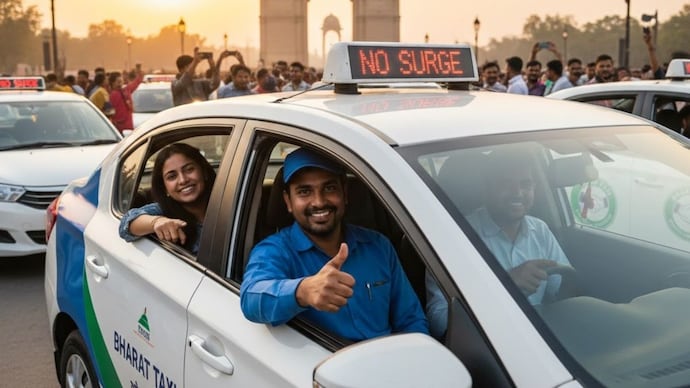

Amul is not just a brand of butter or milk. It symbolizes what happens when millions of small players come together to take on the giants. Now, a new entrant called Bharat Taxi is trying to become the originator of ride-hailing services by giving drivers the power to run the show. It is launching in India on January 1, 2026, and is already being tested in select locations across the country. But why comparison with Amul? Because, like the dairy giant, Bharat Taxi is also hoping to rely on the cooperative model to succeed.
The premise of Bharat Taxi is simple. It is a co-operative initiative, just like Amul, which means that in principle there is no profit-making private organization behind it. Instead, it is a service to thousands of drivers who have joined hands to establish a cooperative. This is good news for both drivers and customers who have chosen to use the service. Well, potentially.
Who is behind Bharat Taxi?
At the helm of Bharat Taxi is New Delhi-based Sahakar Taxi Cooperative Limited. The leadership is already “Amul-heavy” – some more Amul flavour – with Amul managing director Jayen Mehta serving as chairman. The service is supported by the Ministry of Cooperation, Government of India and integrated with the National e-Governance Division (NeGD). Those names may bring credibility, but the real stars are the drivers themselves. They are business owners.
Unlike private enterprises – and potential future competitors like Uber and Ola – Bharat Taxi operates on a zero-commission model so drivers can take home almost all the money they earn by the end of a typical workday. There are no numbers we can confirm at this point, but reports indicate an amount anywhere between 80-100 percent. However, we believe that some part of the earnings will have to be deposited in the organization to run it smoothly.
In other words, they may have to pay some platform fee to the cooperative society daily or monthly. Drivers for competing services like Ola, Uber and Rapido often complain that they are left with very little after fuel, car EMI and the 20-30 per cent commission charged by the platforms. These relatively higher earnings are probably the biggest incentive that comes from interest. Bharat Taxi reportedly garnered over 51,000 enrollments within 10 days of the announcement.
The incentives do not end here. Drivers are not just participants. They have a seat at the table. It has been told that the governing board of Sahakar Taxi will include elected driver representatives.
Meanwhile, commuters can expect an end to “surge pricing” that can double or triple fares in app-based cab services during rainy or peak hours. If you visit a location frequently, such as home and work, it’s much more likely that you’ll be charged the same (or close) each day rather than getting a random amount that some days looks like someone pulled a chit out of a hat. We’ll see about that once the service becomes more widely available.
Cooperative vs. Corporate?
The big question is, will the cooperative model work for something like an app-based taxi service? The “Amul Model” succeeds because of trust and volume. Bharat Taxi does not need to be more profitable than Uber or Ola. It needs to be more durable for the driver. Let’s say if a driver earns Rs 500 more per day because there is no commission, they are more likely to stay on the app. If a passenger saves Rs 250 because there is no bounce, they will use the app and recommend it to others too.
However, the challenge is technology. Private apps have spent years refining algorithms for ride-matching and GPS accuracy. To counter the “experience” of the incumbents, Sahakar Taxi Cooperative chose to use the same backend technology that runs the ONDC-supported Namma Yatri app. Bharat Taxi app is created by the same developer – Moving Tech Innovations. India Today Tech recently tested it and it mostly works as intended. Given that it’s still in beta, we can expect further improvements and refinements closer to launch and beyond.
However, the real test will be on the field. The biggest difference between it and Amul is that while in case of Amul the people producing milk and butter are not directly involved in the distribution, in Bharat Taxi the driver owns everything. In the Amul model, the product is a finished dairy item. And not farmers. In the case of app-based taxis, the product is the driver and the car. Real-world conditions on the road are expected to be dynamic and human factors – whether driver or rider – will always play a role.
At the moment, it is difficult to say how Sahakar Taxi Cooperative will handle both riders and drivers on its platform. And then there are the edge cases. Who takes the blame when something goes wrong on the road – the driver or the co-worker – and how is it resolved? These are the questions that Bharat Taxi needs to not only answer, but also ensure it gets right once the services are operational.

Two examples of cooperative taxi services
We’ll see how Bharat Taxi will work, but if we’re looking at similar examples that are already running, we can think of two. The person is quite successful and progresses rapidly. And the second one, which may not be an official affiliate, is kind of a hellish trip for customers.
Its successful example is from New York. In the city, Drivers’ Cooperative has been operating since 2021 as a driver-owned alternative to ride-hailing giants like Uber and Lyft. Despite challenges, including Big Tech’s huge marketing budgets, it remains the largest cooperative of its kind in the United States to date.
Then we have Goa taxi owners, who may not be officially cooperative, but they certainly seem to be cooperating with each other when it comes to offering their services to riders. Unlike the New York Drivers’ Cooperative, Goa’s taxi unions act as a lobbying powerhouse, preventing major aggregators like Uber and Ola from operating in the state for so-called “local interests” and overcharging customers even for short trips. Any efforts to change this narrative, including Goa Transport Aggregator Guidelines from the government to regulate the industry, have faced significant resistance and opposition from local drivers and the broader unions they are officially or unofficially part of.
Only time will tell which direction Bharat Taxi will go.