


Anthropic Cloud hires philosopher to teach AI etiquette and ethics
It has long been feared that AI will take over humans. To avoid this disruptive future, Anthropic has now decided to teach its AI models, the cloud, ethics and morality so that it can help humans more safely. And the company has given this responsibility to philosopher Amanda Eskel and her team, who are teaching the AI model how to respond to ethically complex scenarios.
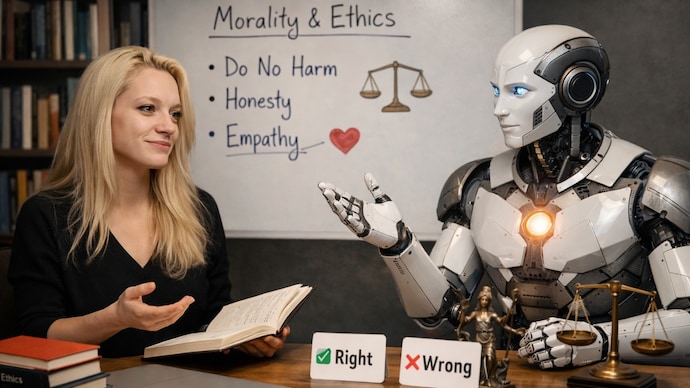

Anthropic has hired a philosopher to teach its artificial intelligence the difference between right and wrong. Meet in-house thinker Amanda Eskel, who was tasked with teaching the company’s flagship chatbot Cloud about knowledge, existence, and wisdom, and shaping its moral compass. Amanda, a philosopher by profession, works at Anthropic and investigates how Claude reasons, identifying where his thinking may go wrong, and guiding him toward more responsible behavior.
Anthropic, one of the most watched AI start-ups currently, focuses on making its AI models smarter and more human-like. The company is already training its large language models (LLMs) on huge amounts of data, but to make them ‘safer for humans’, Anthropic has now decided to teach its AI ethics as well, and this task has been given to Amanda and her team.
Amanda’s job is to teach Claude morality. Their work includes studying the cloud’s reasoning patterns, engaging it in extended conversations, and testing how it reacts to morally complex scenarios. By analyzing its answers, she tries to understand not only what the model says, but also how it reaches those conclusions.
“I’m a philosopher working on fine-tuning and AI alignment at Anthropic. My team trains models to be more honest and have good character traits, and works on developing new fine-tuning techniques so that our interventions can lead to more capable models,” reads her official bio on the company’s website.
According to a report in The Wall Street Journal, Amanda and her team’s work goes far beyond making the chatbot polite. Instead, Amanda is helping AI develop a sustainable sense of identity. The goal is to ensure that the cloud understands itself as a helpful and humanizing assistant, not as a system that can be manipulated, forced, or pushed into harmful behavior. In simple terms, she is helping Anthropic create boundaries around safety, so that future AI does not cross into unethical territory and harm humans. Many people become worried whenever there is talk of AI-led disruption or machines taking over human roles.
Before joining Anthropic, Amanda worked as a research scientist in the policy team at OpenAI, where she focused on AI safety through debates and human baselines for AI performance.

As for Anthropic’s decision to hire a philosopher, it comes amid increasing scrutiny of AI systems. Chatbots, whether cloud-based or rivals like Google’s Gemini or OpenAI’s ChatGPT, are facing criticism over instances where users made deep emotional connections or received problematic advice. While many companies rely heavily on technological fixes and content filters, Anthropic also wants to keep AI in line by shaping its internal “character.”
This also seems to be the right approach as the company recently released a study examining potential flaws in its models, including concerns about whether advanced systems like Cloud Opus 4.6 could be misused in harmful ways. In that context, bringing philosophy into the training process can be really useful for building guardrails into AI models.