



After Sundar Pichai lauds coding vibe, Zoho CEO Sridhar Vembu says coding is magic in every way
Zoho CEO Sridhar Vembu has slammed the growing hype over “vibe coding”, just days after Google CEO Sundar Pichai called it the future of software development. According to Vembu there is deep complexity and “magic in every way” in the actual coding.


With the rapid integration of artificial intelligence into everyday work, the vibe of coding has become increasingly polarizing in Silicon Valley. While one group is lauding how it accelerates prototyping and creativity, allowing coders to quickly generate and iterate ideas with AI. There is also another group that is criticizing it for being unreliable and completely eliminating the fundamentals of coding. And Zoho founder Sridhar Vembu appears to be on the other side.
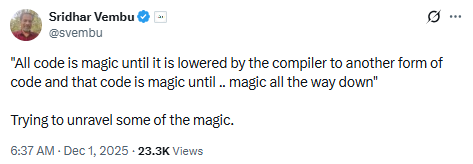
Days after Google CEO Sundar Pichai praised the rise of “vibe coding” and called it an emerging trend, Zoho CEO Sridhar Vembu has now offered an opposite view. In a recent post on He wrote on
What does Pichai mean by vibe coding?
Google CEO Sundar Pichai is one of the strongest proponents of vibe coding. He previously described this new trend as a major change in the way people, especially non-engineers, create software. Speaking on the Google for Developers podcast with Logan Kilpatrick, Pichai said Vibe is making coding programming “more enjoyable” and “more accessible”, allowing anyone to build apps and websites without knowing languages like Python or JavaScript.
Pichai argues that vibe coding gives non-technical employees “the power to visualize ideas directly.” Instead of having to explain an idea to an engineer, users can prototype it themselves with AI. He said, “You might be interested in coding it a bit and showing it to people.” And as Logic models improve, including Google’s newly announced Gemini 3, which Pichai calls its “ultimate vibe-coding model,” the trend is expected to accelerate.
However, Zoho founder Sridhar Vembu is now pushing the idea further with a reminder that coding can’t be completely limited to natural-language signals. He emphasizes that behind every convenient AI interface are many complex layers of code, compilers, optimizations, and abstractions, which remain fundamental to the way computers actually work.
Although Vembu did not directly criticize vibe coding, he highlighted the depth and complexity of the craft. Interestingly, his point echoes one of the concerns expressed by Pichai in the podcast, that AI-generated code may not be suitable for large, security-critical systems, and experienced engineers will still be necessary.
What is vibe coding?
The term “vibe coding” was coined earlier this year by OpenAI co-founder Andrzej Karpathy. They used it to describe a process where you tell what you want in simple English (or any natural language) to an AI coding assistant like Windsurf, cursors, or OpenAI’s codec-powered tools. The AI then generates working code, modifies it on demand, and even fixes bugs through conversation.
This approach has now exploded in popularity in recent months as more people are turning to AI tools for everything from writing emails to making sales pitches. Major tech companies are adopting it internally as well. Satya Nadella recently revealed that about 30 percent of Microsoft’s code is now written by AI, while Pichai said that more than 25 percent of new code at Google is machine-generated.