


After SaaS scare, Anthropic launches new cloud AI with agent teams that builds C compiler on its own
Days after putting SaaS companies on alert with Cloud Cowork, Anthropic has now revealed that its Cloud Opus 4.6 model can build a C compiler from scratch. That’s why it’s a big deal.


Anthropic, the AI startup that shook the stock market a few days ago with Cloud Cowork, has revealed that its Cloud Opus 4.6 model can build a C compiler from scratch. This was the result of an experiment with 16 cloud AI agents working together to accomplish this impressive feat.
On Thursday, Anthropic shared a blog post detailing the experiment, which was led by Nicolas Carlini. Carini wrote that 16 parallel cloud agents were tasked with developing a Rust-based C compiler capable of compiling the Linux kernel.
Within two weeks, agents running on Opus 4.6 models created a 100,000-line compiler with minimal human intervention. This compiler was built without Internet access, and took approximately 2,000 sessions and $20,000 in API costs. The C compiler can create bootable Linux 6.9 on x86, ARM, and RISC-V.
Cloud Opus 4.6 is Anthropic’s latest AI model. The model has introduced a new “Agent Team” feature that allows multiple AI agents to work together on the same project. Each agent will complete different parts of the project, leading to better efficiency and productivity.
Why is Anthropic’s Cloud Opus 4.6 experiment a big deal?
There was a flood of reactions on social media after the AI startup announced this experiment on X. Professor Derya Unutmaz of The Jackson Laboratory wrote, “You’ve got to be kidding me!”
But why has it shocked people? A compiler is a software program that translates human-readable source code written in the C programming language into machine-readable instructions that a computer’s central processing unit (CPU) can understand and execute. This allows the computer to receive instructions in binary code (0s and 1s).
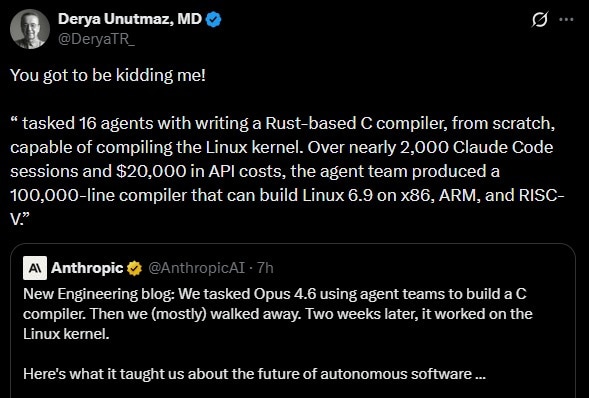

It is believed that this program is a highly complex task, and even experienced programmers may struggle when building a C compiler from scratch. In such a situation, the use of Anthropic has influenced many people.
How does Cloud C compiler perform?
Major technical innovations in the Anthropic experiment included a parallel workflow, where each cloud agent worked within its own isolated container, and a simple synchronization mechanism. This allowed efficient division of labor and conflict resolution among agents.
The C compiler built by Cloud Agents was evaluated against challenging benchmarks. It passed 99 percent of the GCC torture test suite and was even able to compile and run the classic game Doom. However, the compiler has limitations, including the lack of a 16-bit x86 backend required for Linux booting, reliance on GCC for some steps, and lower efficiency than established compilers.
The rigor of the test proved important. Carlini explained that continued progress requires “extremely high-quality tests” and continuous integration pipelines to ensure that new commits will not break existing code. Writing explicit validator scripts and maintaining up-to-date documentation enabled cloud agents to self-orient between tasks and overcome context loss – a common challenge with current language models.