



Physicists have successfully recreated some of the extreme physics of a black hole inside a laboratory by building a stable device that can mimic the effects of impossible rotational motion.This achievement confirms a theoretical idea suggested more than half a century ago by Sir Roger Penrose, who proposed that energy could be extracted from rapidly spinning black holes. Instead of using moving parts, researchers at the Advanced Science Research Center at the CUNY Graduate Center (CUNY ASRC) used artificial rotation to recreate this cosmic energy process in a controlled laboratory setting.The discovery, published in the journal Nature, takes a long-standing idea from science fiction to practical physics. Laboratory models avoid the physical limitations of mechanical machines and can help create new technologies in wireless communications, advanced optics, and quantum computing.
breaking material speed limits
In 1969, Penrose suggested that if a particle entered a black hole’s ergosphere, a strange region where the black hole’s rotation drags space and time with it, the particle might split into two. One part will fall beyond the point of no return, while the other part may escape with more energy than the original particle.Physicist Yakov Zeldovich later expanded on this idea, showing that light and radio waves can also gain energy and become stronger by colliding with an object rotating at extremely high speed.For decades, scientists could not test the idea in the laboratory using actual motion because solid material would fall apart under the extreme forces required to mimic a rotation like a black hole. To overcome this problem, the CUNY ASRC team created a completely stable radio frequency ring made of specially designed metamaterials.Instead of physically rotating the device, the researchers used carefully timed changes in the electrical properties of electronic components placed around the ring. This controlled timing created a moving wave pattern that mimicked the physics of an object rotating faster than the speed of light.“Our approach facilitates a new method of wave-matter interactions in which waves with selected rotational properties extract energy from synthetic time-engineered rotations, creating broadband selective amplification,” said principal investigator Andrea Ali, Einstein Professor of Physics at the CUNY Graduate Center and founding director of the CUNY ASRC’s Photonics Initiative.
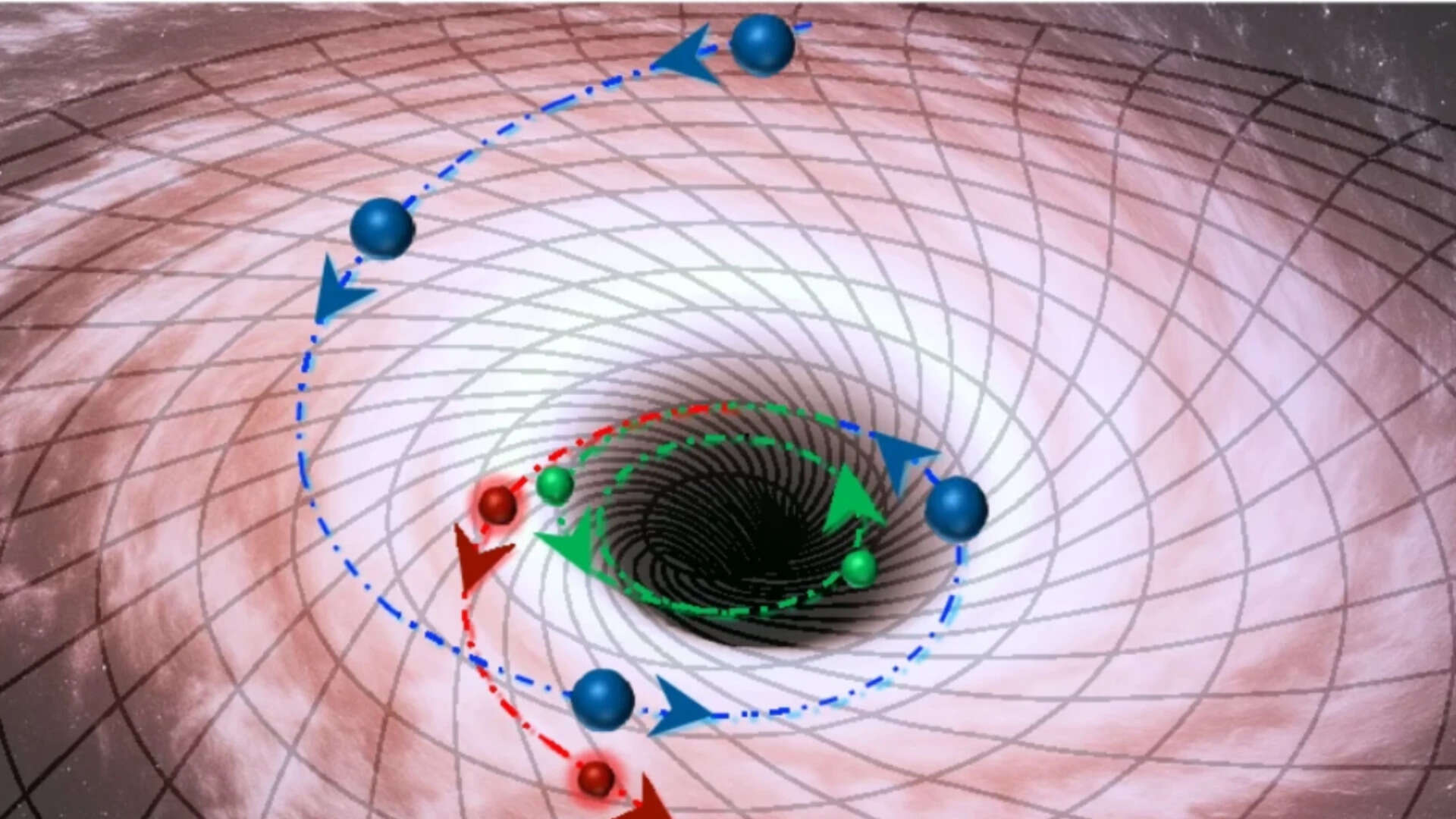
CUNY physicists recreate black hole energy extraction in a historic lab experiment

Creation of energy through artificial motion
The main part of the experiment depended on how electromagnetic waves reacted inside this artificial environment. When radio waves with certain rotational characteristics enter the stationary ring, they interact with the changing patterns created by the researchers. The waves gained energy from the artificial motion of the system and became stronger.“Waves with appropriate rotational characteristics extracted energy from the system and were amplified, reproducing the essential physics of the Penrose-Zeldovich process,” said co-lead author Haddy Moussa, a former PhD student in the CUNY ASRC Photonics Initiative. “Our approach relies on engineered metamaterials that are designed to control the propagation of waves.”By removing the need for actual physical rotation, this experiment provides scientists a safe way to study the natural laws that typically occur near the edges of black holes.“This successful experiment advances ideas about extreme rotational dynamics from theory to practice and creates a versatile experimental platform for exploring a wide range of phenomena at the intersection of astrophysics, wave physics, and quantum science,” said lead author Hadise Nassari, a postdoctoral researcher in CUNY ASRC’s Photonics Initiative. “This work has implications for fundamental science and advances in communications, optics and photonics.“
Real-world applications of black hole physics
Although the experiment helps astrophysicists understand extreme space conditions, the technology behind it may also have practical uses on Earth. The ability to enhance specific waveforms using motionless artificial rotation could help engineers create more efficient parts for future wireless communications systems and radar technology.The research team plans to miniaturize the technology and test how it works with light-based photonic devices and quantum systems. If successful, this method could allow engineers to control how light moves through computer chips, potentially creating faster data processing systems.The project received support and funding from the US Department of Defense (DOJ), the US National Science Foundation, and the Simons Foundation. Metamaterial rings will require further improvements before the technology can be used in commercial communications devices.