



Pinaka teaser review: Ganesh’s Kannada film has big ambitions, big red flags
The teaser of Kannada actor Ganesha’s mythological tale Pinaka unveils a world of sacred symbols and war. It arouses curiosity for its concept, but its CGI-heavy execution raises doubts about the scale of the film.
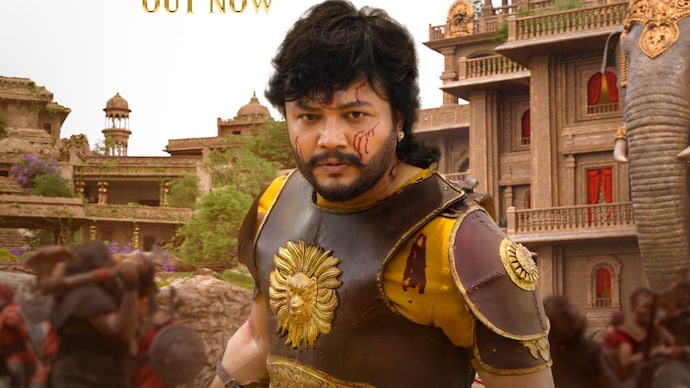

Every big pan-Indian fantasy teaser today seems to follow a familiar blueprint. Ancient mythology, larger-than-life scenes, slow-motion hero shots, huge battle sequences and enough CGI to convince the audience that they are about to watch an epic. Kannada actor Ganesh PINAKA Follows the same path.
In less than two minutes, it introduces a world filled with temples, sacred symbols, references to Lord Shiva, and the impending battle between good and evil. The mythology is interesting, but the execution raises more questions than excitement.
❮❯
First of all, Ganesha’s ambition deserves special praise. It’s different from anything he’s tried before. Rather than sticking to a familiar commercial or family entertainer, he has chosen a mythology-inspired fantasy set on a pan-Indian canvas. Actors taking such creative risks in Kannada cinema deserve encouragement, and there is genuine curiosity to see them in this new space. Unfortunately, the teaser struggles to match that ambition.
Views are of greatest concern. Almost every wide shot appears to be digitally assembled rather than organically constructed. The environments rarely look alive, and the excessive CGI constantly reminds you that you’re looking at computer-generated imagery rather than being pulled into the world of the film. Instead of serving the story, the visual effects become the center of attention, and not for the right reasons.
Equally difficult to ignore is the widespread use of AI-assisted imagery. This was clear from the first announcement of the film and the teaser reinforces that notion. Using AI or advanced technology is not the problem. Cinema has always evolved with technology. The problem arises when the audience pays more attention to the technique than to the storytelling. In PINAKAMany shots have an artificial finish that takes away from the scale that the film is trying to achieve.

The war scenes further highlight these shortcomings. These moments should have sold the grandeur of the film, but instead they feel surprisingly weak. Many frames look oddly empty despite attempting to depict large-scale battles. The background actors often appear to be going through awkwardly choreographed movements rather than participating in any intense conflict. Instead of creating chaos, urgency and spectacle, the action is organized unevenly, creating an illusion of scale collapsing.
This naturally raises questions on production values. This is not a small independent production with limited resources. PINAKA People is backed by Media Factory, a banner that has launched a number of visually ambitious projects over the past few years. In 2026, the audience has also become much more demanding. The shorter presentations would have provided far more solid visual effects, making this teaser feel less like a tech showcase and more like an early warning sign.
Frankly, it would be too early to evaluate the entire film based on a teaser, which reveals very little about its story. The mythology, fantasy elements, and spiritual backdrop remain interesting enough to keep you curious about what happens next. At the launch event, director Dhananja also hinted that the teaser only shows a small part of the film and its emotional and spiritual essence is still to be seen.
But a teaser has a simple responsibility: to instill confidence. PINAKA It succeeds in generating curiosity about its concept but struggles to inspire confidence in its implementation. At the moment, it feels like this is a film chasing a pan-Indian level through digital spectacle, which doesn’t entirely convince the audience that the world on screen is real. Hopefully, the final film will prove that this first impression is misleading.