



Introduction
Today, we get the latest in our ever-growing line of Honor laptops. This is the Pro model for 2026, and as such, it’s quite cutting-edge, which isn’t surprising from Honor. It was one of the first manufacturers to move toward OLED, and has always used innovative 3:2 screens with high refresh rates.
The specifications overview is also quite impressive. Upfront there is a 14.6-inch 3120x2080px OLED touchscreen with a 3:2 aspect ratio and a maximum refresh rate of 120Hz. Inside is an Intel Core Ultra 5 338H processor with 32GB of RAM. It has 1TB storage. The laptop is powered by a 92Wh battery and weighs only 1.39 kg.
You can also opt for a Core Ultra 5 336H or Ultra X9 388H processor and 24GB or 32GB of RAM. All models feature a 1TB disk.
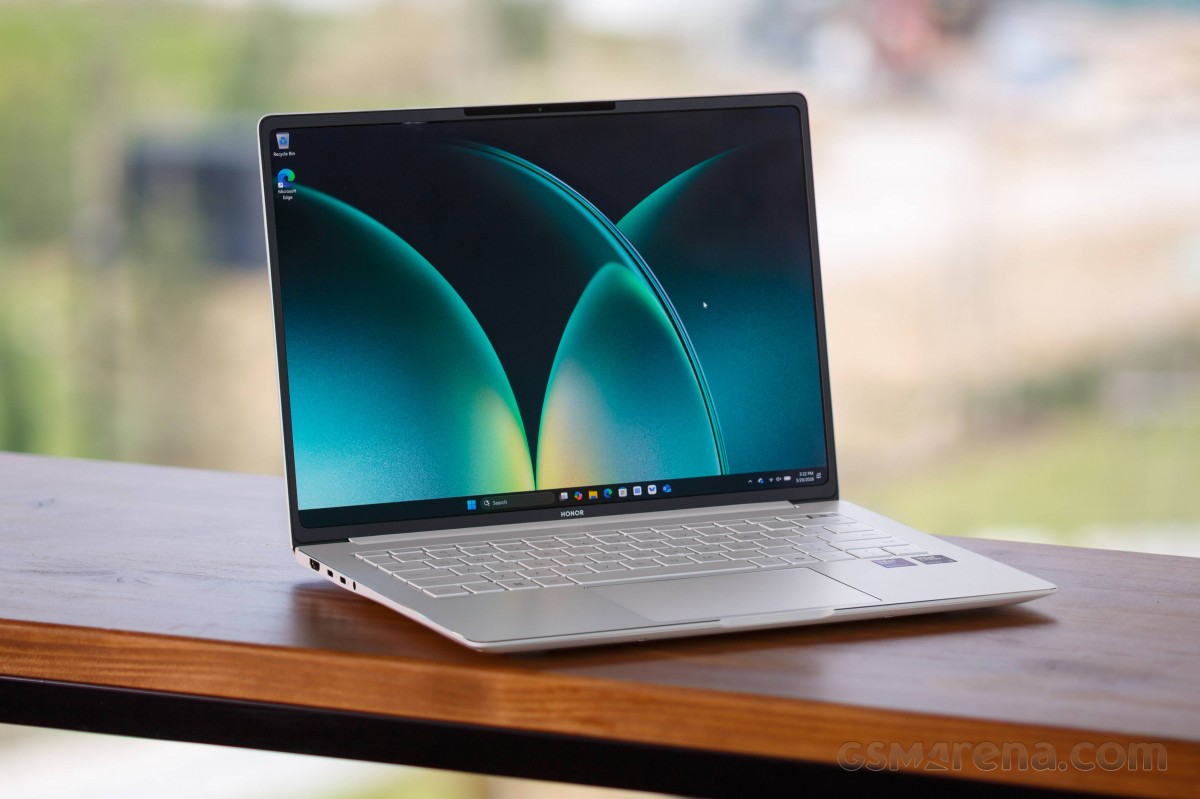
That’s a solid resume, and you’d be forgiven for skipping this entire article and going straight to the “buy here” link. But this is where it gets tricky – finding this laptop and purchasing it is no easy task. At the time of writing, you can buy the 2026 MagicBook 14 Pro in the Middle East, China, and France.
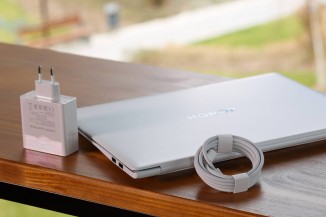
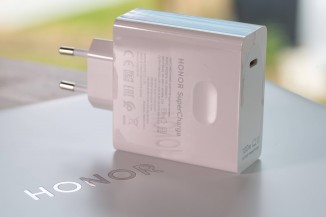
unbox
Table of Contents:
- Design and port
- Display and keyboard, sound
- Performance and battery life
- decision
Design and port
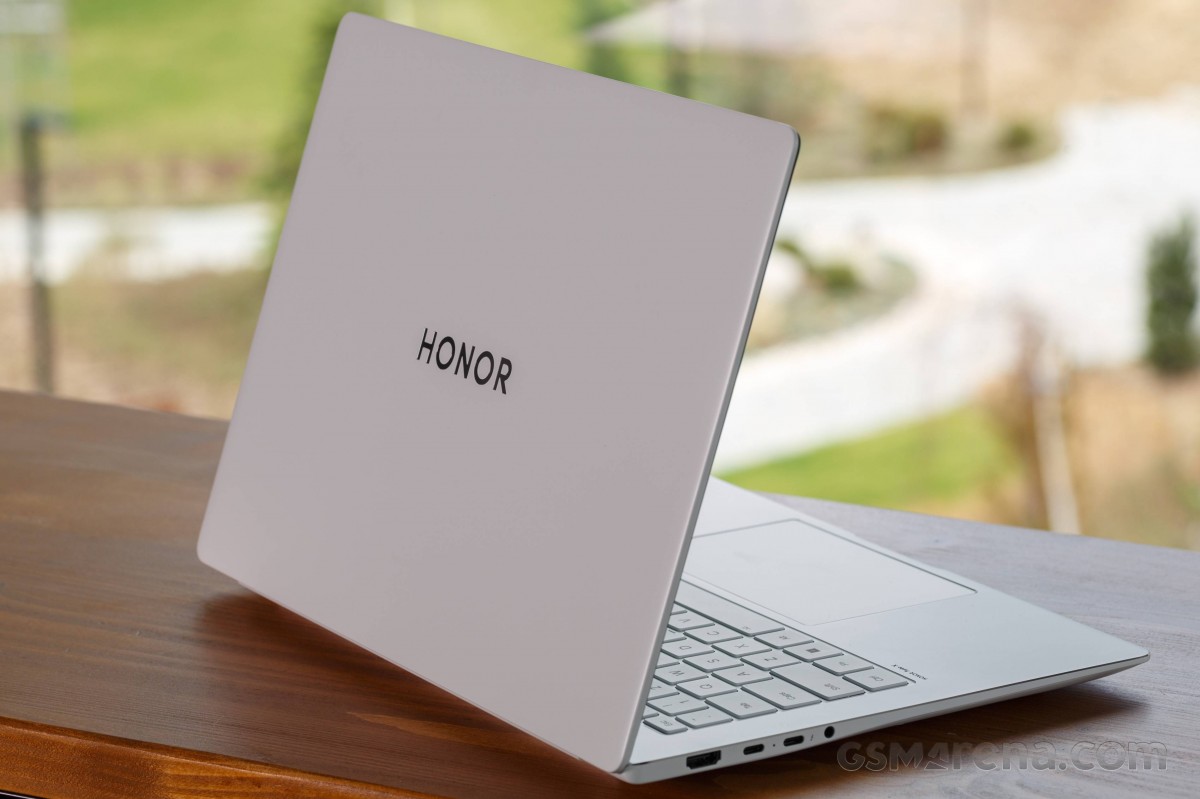
Honor hasn’t tinkered with the design of this year’s MagicBook Pro, and it looks essentially the same as the MagicBook Pro and its predecessor. But that’s not a bad thing, as these laptops never go out of style. The laptop is all-metal and has a precise, high-quality unibody design.
The lower deck has a vine-leaf edge, which is widest near the rear (where the ports are), and tapering towards the front of the machine. Both edges are slightly curved.
You can get the MagicBook Pro 14 (2026) in Starry Gray or White, which is the unit we had available for review. Like the previous generation Honor MagicBook laptop, it has a pearlescent finish, which has a satin, glossy finish. Honor calls this the pearlescent electrophoresis process.
However, despite looking almost identical, the MagicBook Pro is heavier than the Art model. It is about 1.4 kg, whereas those machines are more than 1 kg larger. It’s a noticeable difference – the MagicBook Pro 14 (2026) feels heavier. But when compared to the 14-inch MacBook Pro or 15-inch MacBook Air, which are both around 1.5 kg, the MagicBook Pro 14 feels thinner and lighter.
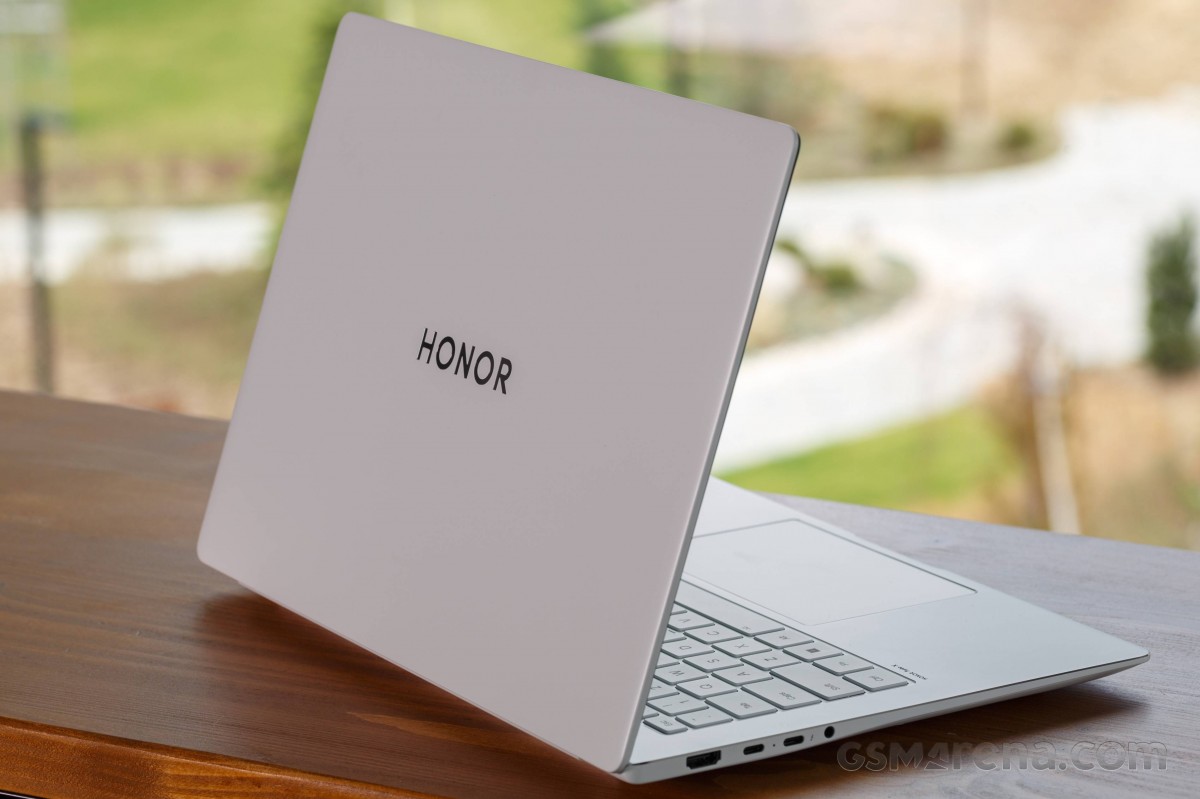
The port selection on the MagicBook Pro 14 (2026) is great. On the left, you’ve got an HDMI 2.1, a USB-C 3.2 (10Gbps), and a Thunderbolt 4 USB-C 4.0 (40Gbps) – both with DisplayPort and Power Delivery. Finally, there is a 3.5mm headphone jack.
On the right side, there are two USB-A 3.2 Gen 1 ports (5Gbps). This means you can’t charge the laptop from the right side, and there’s no USB-C port there (nor is there a USB-A port on the left side). The lack of Thunderbolt 5 is also notable, though it’s not a dealbreaker.
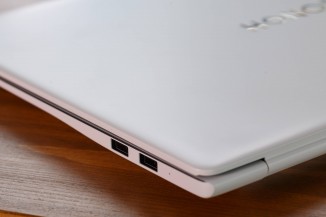
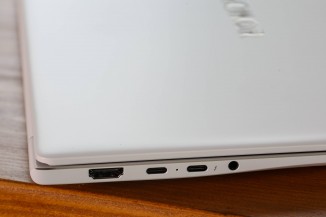
Ports – No USB-C on the right, no USB-A on the left
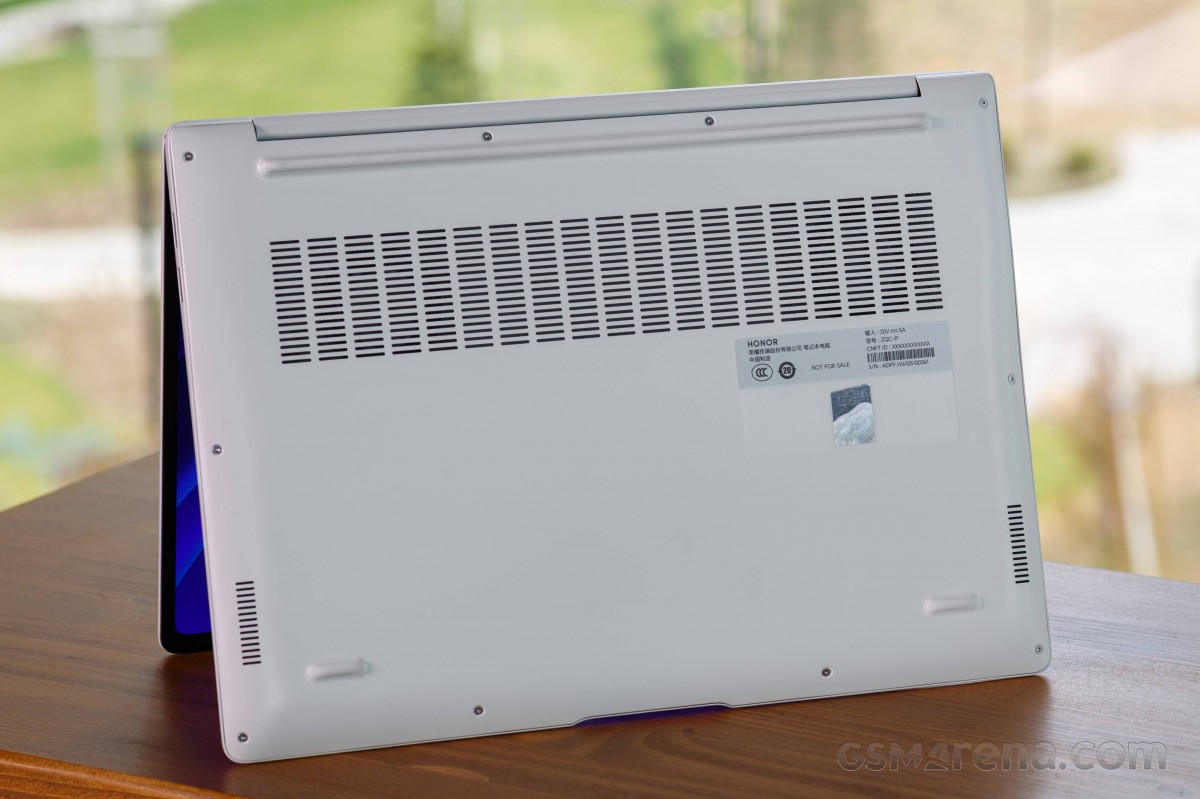
To open the bottom cover you will have to unscrew ten screws. The lid has ample grills for airflow and three rubber pads to keep it held up.
Display and keyboard, sound
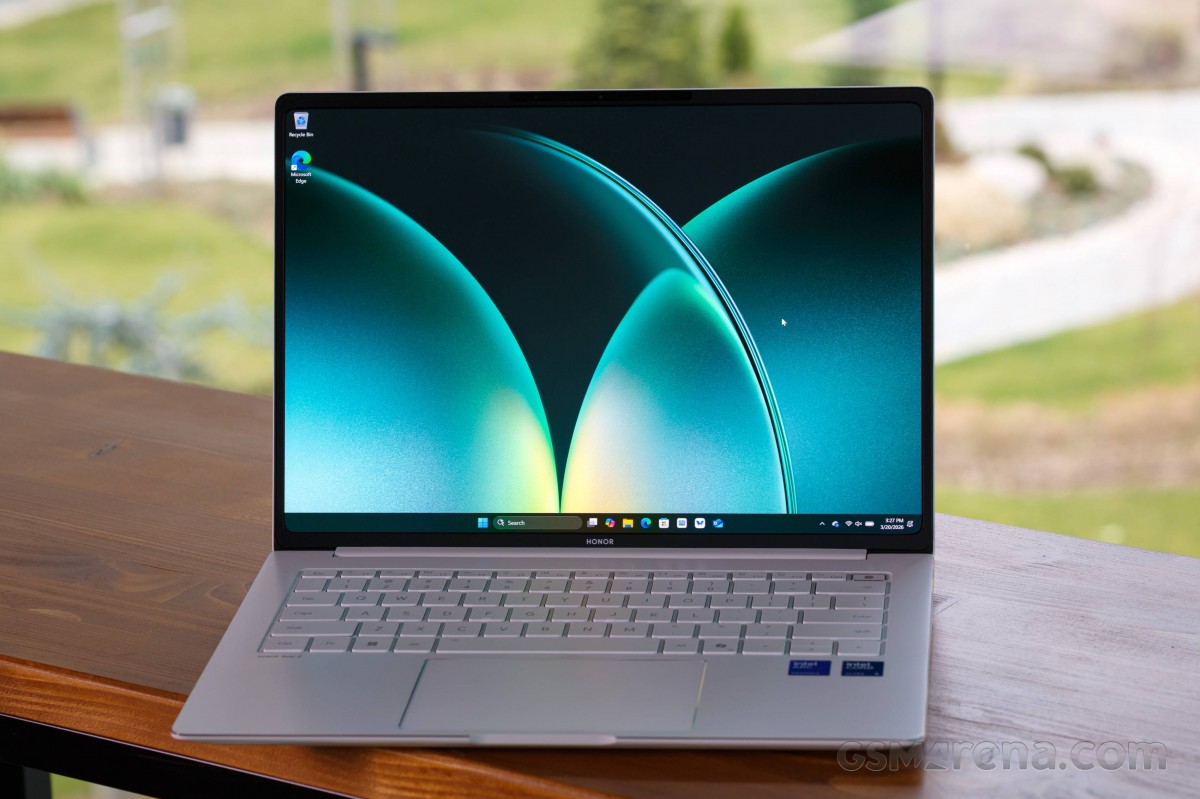
The display is the centerpiece of the MagicBook Pro 14 (2026). The panel measures 14.6 inches and has a resolution of 3120x2080px. It’s a 3:2 aspect unit, meaning it’s taller than your typical 16:9 or 16:10 widescreen, and gives more vertical space for web browsing. It is also better for photo editing.
The OLED panel is a 10-point touchscreen, has 100% DCI-P3 coverage, and supports either a 60Hz or 120Hz refresh rate. The maximum brightness is rated at up to 700 nits. Keep in mind that you can use the screen at 60Hz or 120Hz, it doesn’t refresh dynamically.
Honor has a sophisticated display tuning menu inside its PC Manager app. From there, you can enable a few comfort modes – Eye Comfort, eBook Mode, Comfort Display, AI Defocus, and Dynamic Dimming. All those modes either adjust the color temperature of the display, its brightness, or allow you to make the screen black and white.
Delving deeper, you get into color management. It has 13 presets that tune the screen to the P3 or sRGB color gamut. You can choose the preset you need for your task – P3-D65 Photography for photo or video editing, or sRGB Web and Office for photo editing or designing, or Web work. The display is rated for 100% coverage of the DCI-P3 gamut.
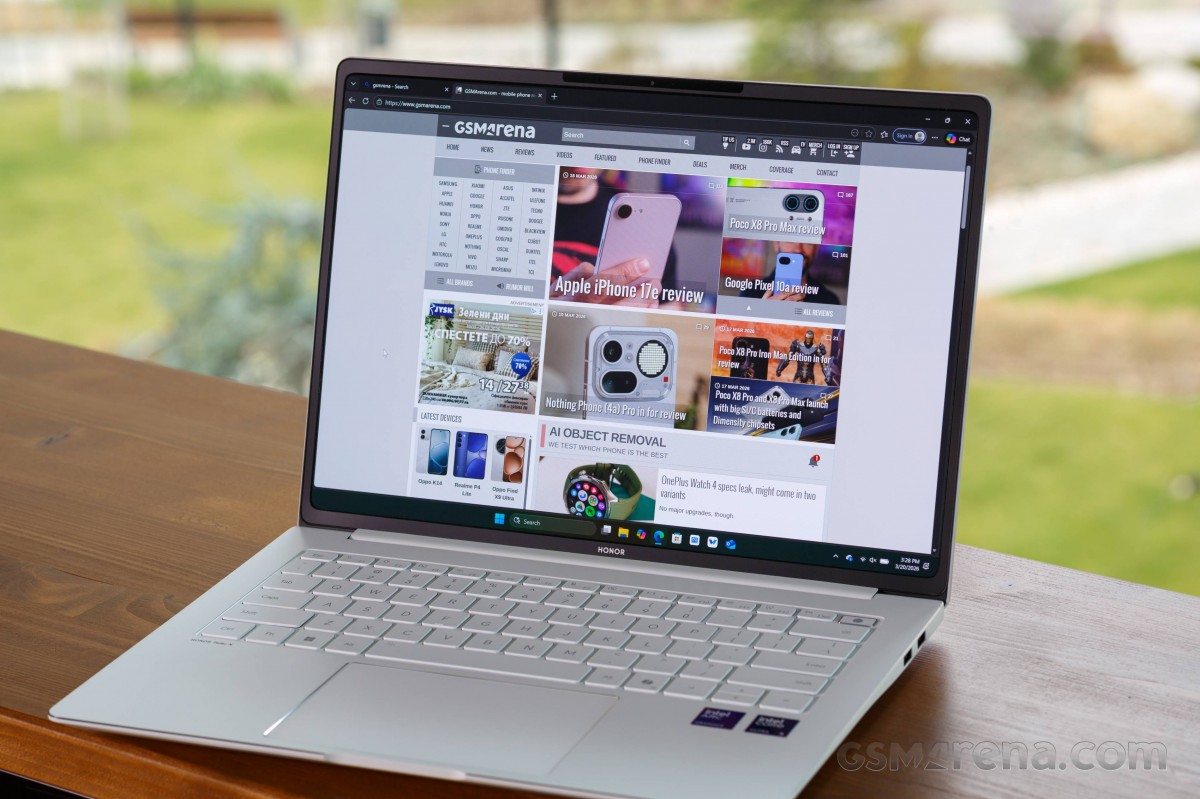
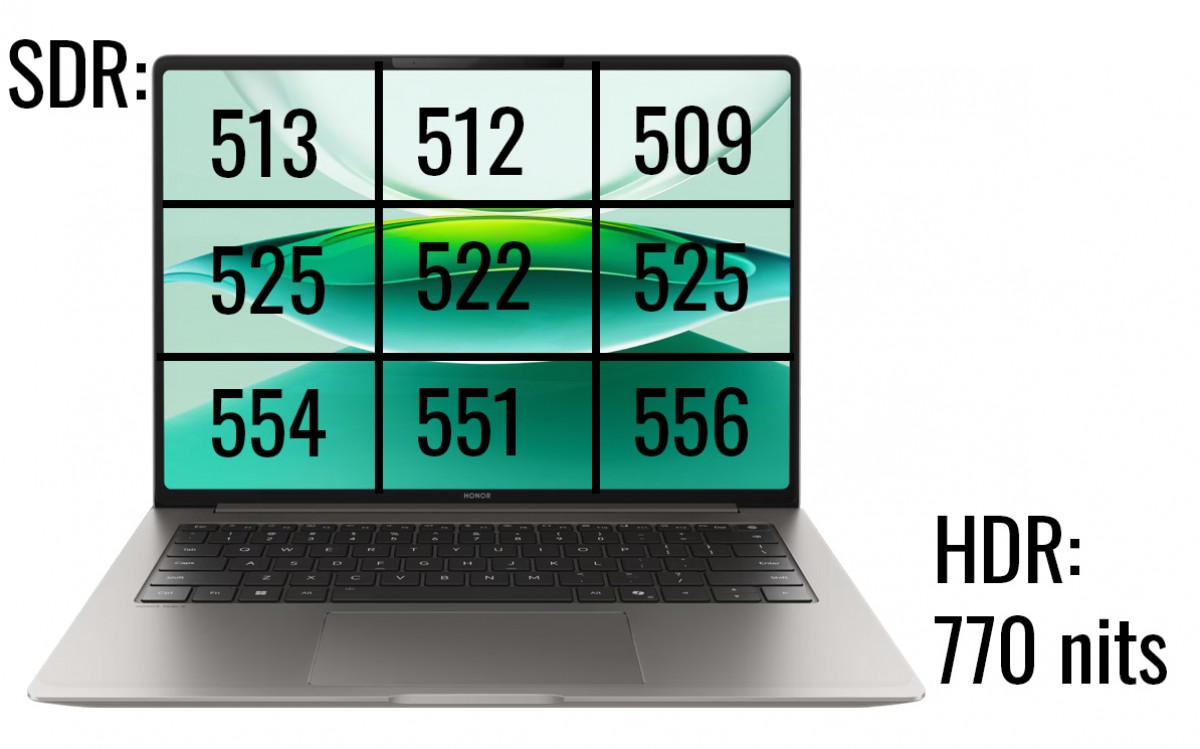
We measured about 500 nits of SDR brightness and about 800 nits of peak HDR brightness. The uniformity is great, and there is an anti-reflective cover. It does a good job of limiting reflections; However, its surface is slightly wavy, which gives an unpleasant effect when viewing the screen from an angle.
In our experience, this is typical of the display panels of Honor laptops, while Huawei-made laptops have a similar, but better, anti-reflective coating that lies flat. Either way, this is not an issue you will notice every day, but it is an observation.
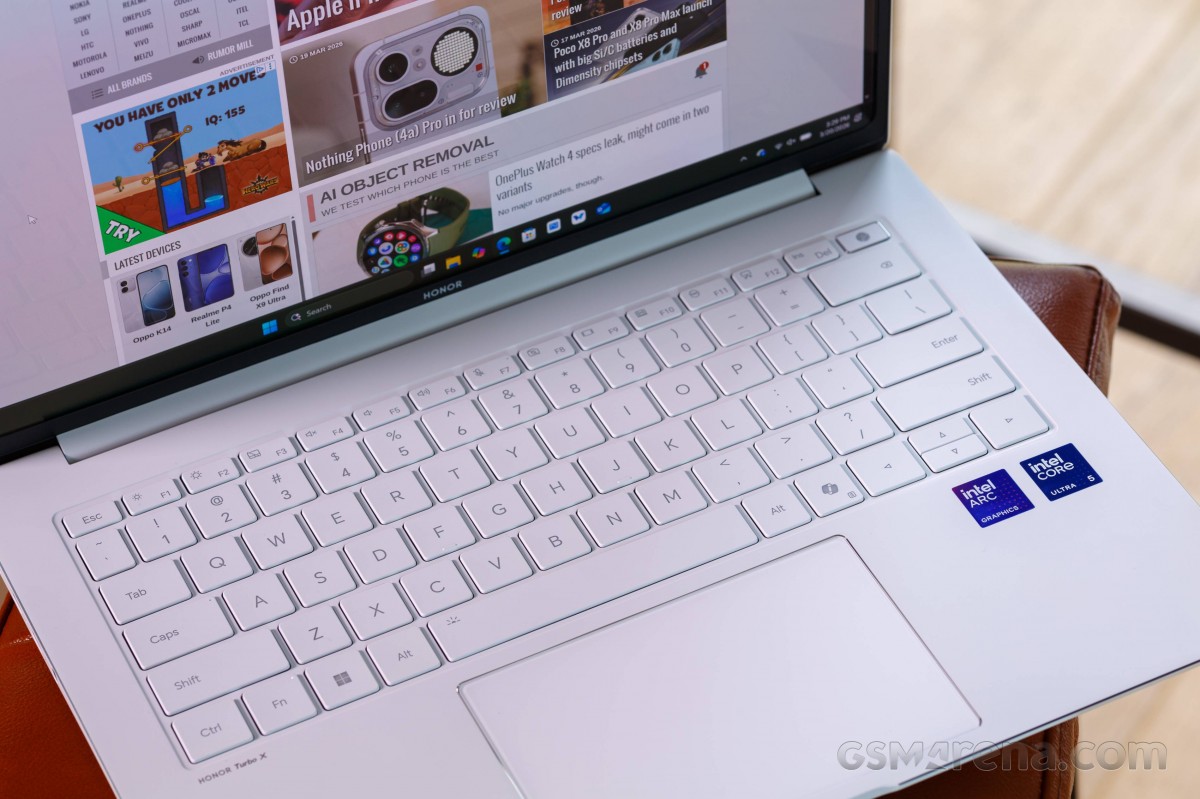
The backlit keyboard is beautiful. The keys have great feedback and a long 1.5mm travel for a comfortable typing experience. Once again, the Art model has a slight advantage with its titanium keyboard, which feels a little more premium and comfortable to type on.
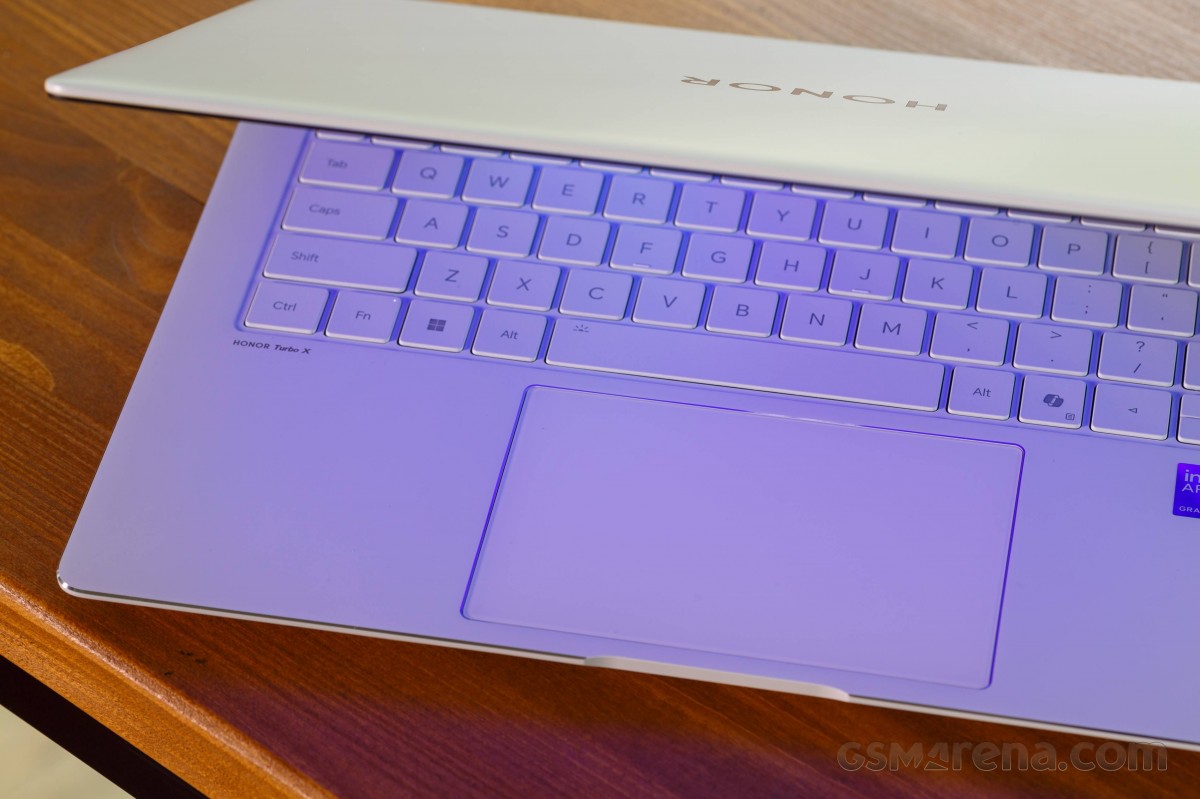
There’s a substantial glass trackpad below the keyboard. It doesn’t extend to the bottom edge of the laptop like the Art, and it’s a bit smaller. But like that unit, this one is a solid-state haptic trackpad, which means you can tap anywhere and it’ll be just as accurate. You can adjust the tracking sensitivity and vibration strength as you like; By default, it is a little stronger.
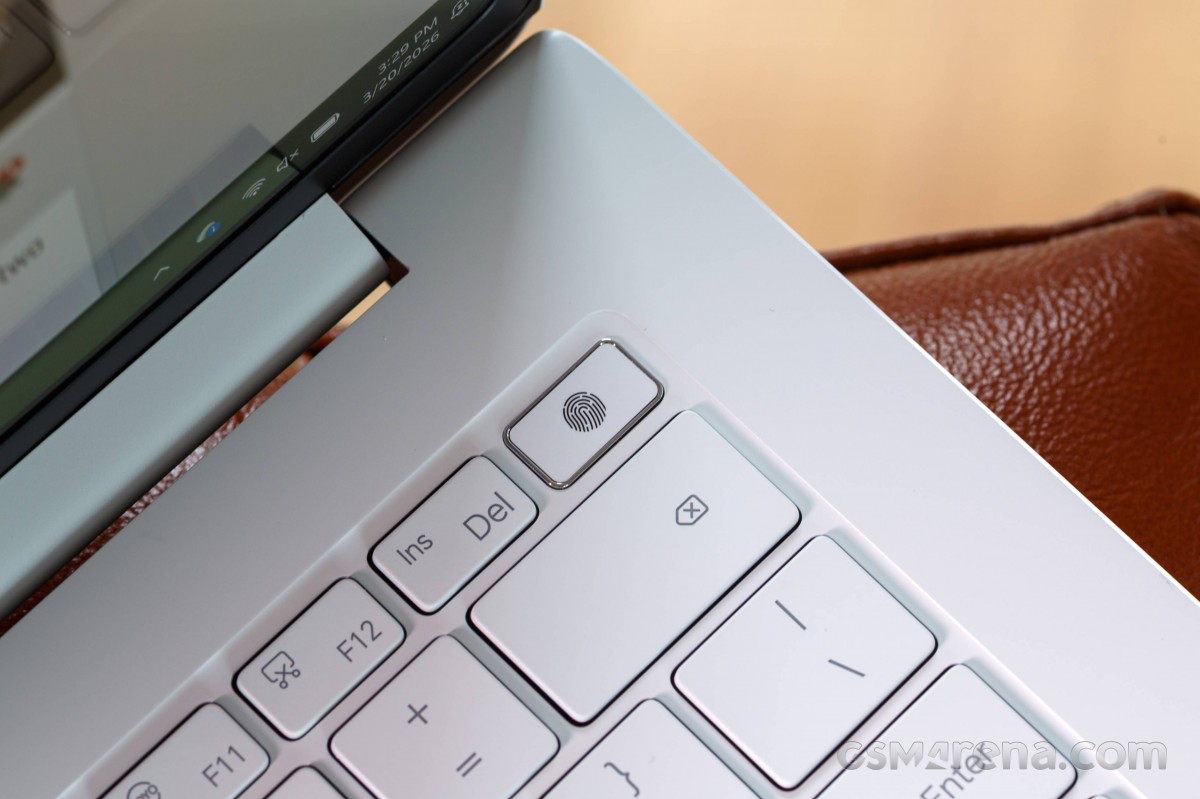
In terms of biometrics, there’s Windows Hello-certified face scanning and a fingerprint embedded in the power button. The fingerprint scanner supports caching, so pressing it will turn on the laptop and log you in.
The MagicBook Pro 14 (2026) has two speakers on either side. They fire from the bottom of the machine, but sound bounces back from any surface your laptop is on (other than your knees or lap). Sound quality is good. Honor’s PC Manager has some presets to tune the sound for music, movies, etc. The speakers are quite loud, but like almost all laptop speakers except the most expensive (and most MacBooks), there’s hardly any bass.
The 1080p front-facing camera is only average.


photos from camera
Performance and battery life
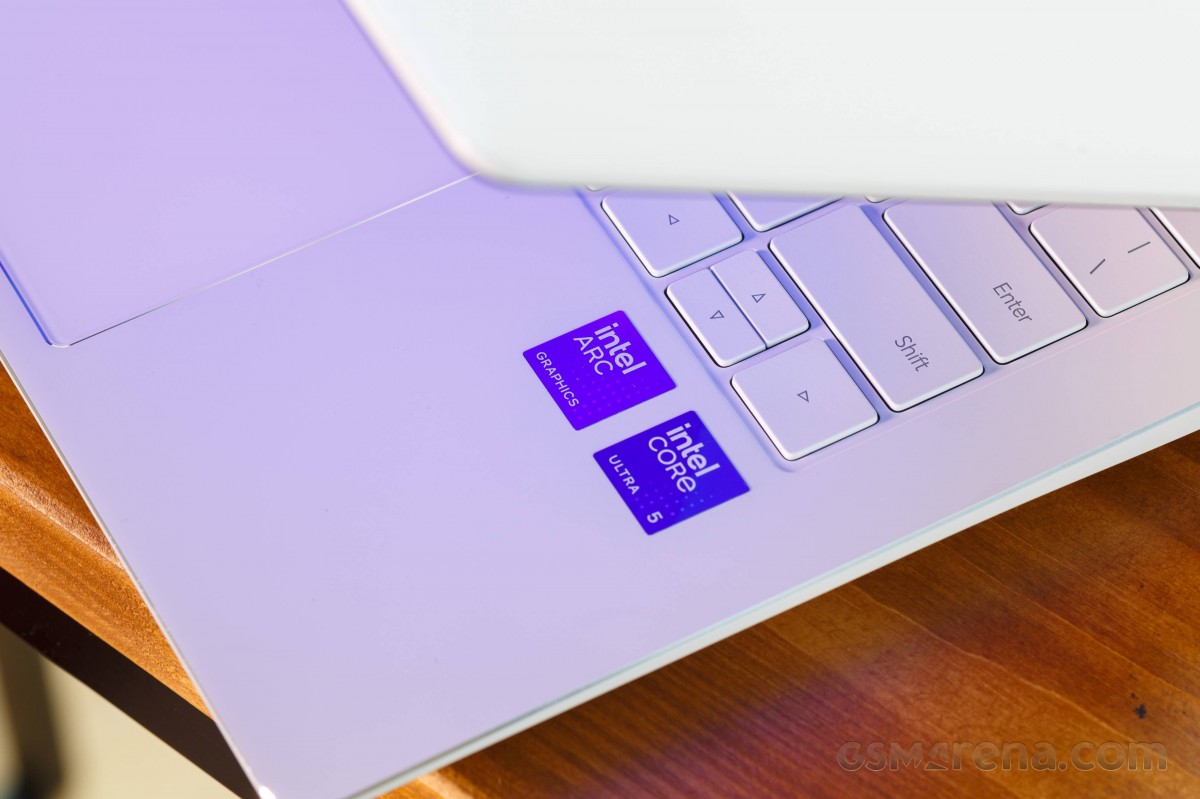
The Honor MagicBook Pro 14 (2026) uses the latest Intel Panther Lake processors, which were launched at CES 2026 in January. They are built on Intel’s 18A architecture, which is an impressive 3nm class node. Our unit comes with a Core Ultra 5 338H with 12 cores (4 performance, 4 efficiency, 4 low-power efficiency). In our unit, the processor comes with 32GB of LPDDR5x 8400 MT/s RAM.
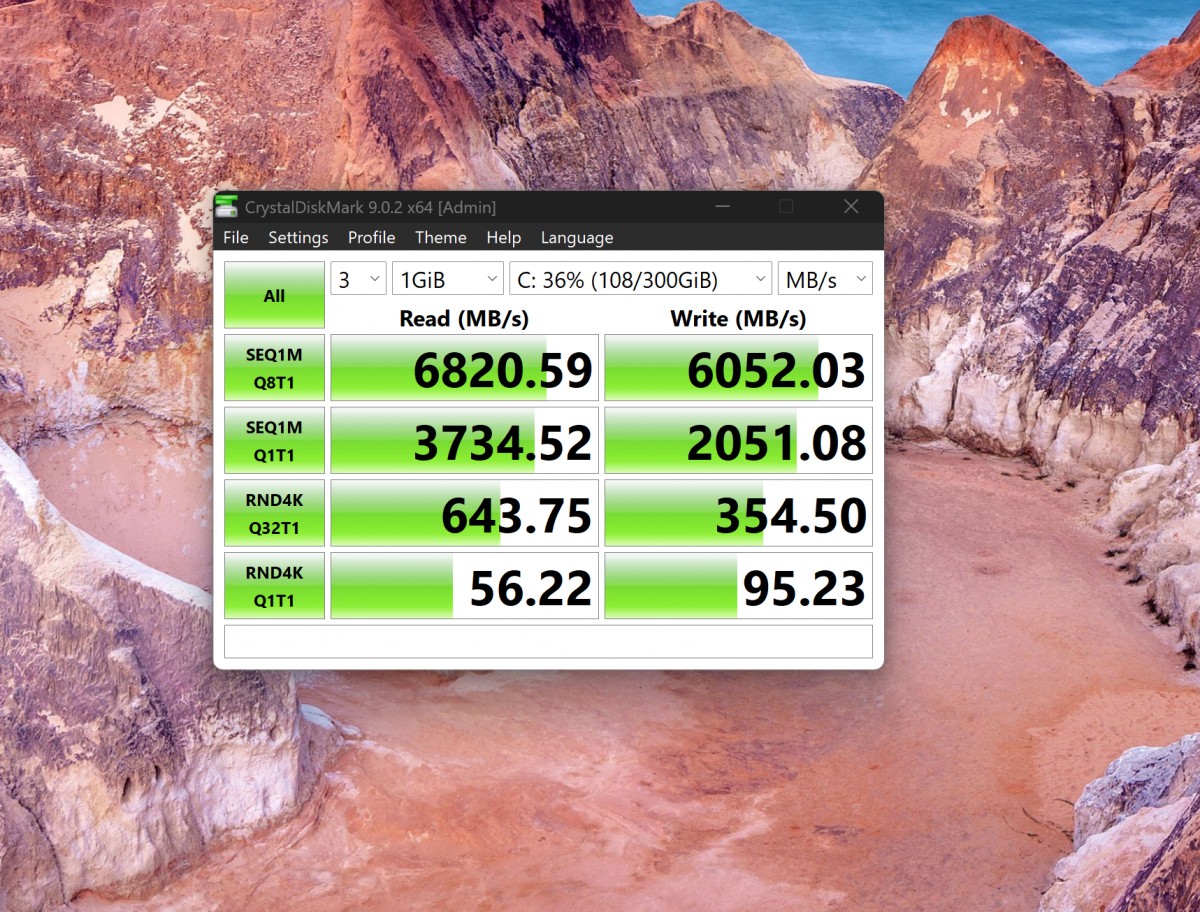
It has two M.2-2280 SSD slots, and is filled with a 1TB YMTC PC411, a PCIe 4.0 x4 drive that is close to PCIe 5.0 level performance in terms of sequential read speeds. The random 4K numbers are solid, too. Sequential writing is “only good” not “great”.

Still, if you buy a PCIe 5.0 drive and swap it with an available 1TB SSD and move it to another slot, you can get some (questionably perceptible) performance gains.
We ran a set of real-world evaluation benchmarks on the MagicBook Pro 14 (2026). Processing performance easily falls into very fast ultrabook territory. Tasks like seamless Lightroom and Photoshop editing, proper 4K video editing (without heavy color grading), and proper 3D rendering are simple.
The integrated GPU offers good performance, and you’ll be able to get away with some triple-A gaming at low to medium settings, but the MagicBook Pro won’t shine for serious GPU rendering.
Finally, AI performance is mid-tier – not on par with recent Apple M4 and M5 processors, nor even AMD’s AI chips. Basic local models will be great, but don’t count on this machine running smoothly for heavy LLM or training.
| benchmark | Examination | Result |
|---|---|---|
| geekbench 6 cpu | single core | 2782 |
| multi core | 14220 | |
| geekbench 6 gpu | opencl | 48376 |
| Geekbench AI (CPU/NPU) | single precision | 3756 |
| half precision | 1639 | |
| set quantity | 7293 | |
| pass mark | CPU | 29950.1 |
| 2d graphics | 810.4 | |
| 3d graphics | 7910.8 | |
| Memory | 3904.8 | |
| disc mark | 42829.7 | |
| overall | 8693.2 | cinebench 2026 | single core | 462 |
| multi core | 3795 |
What’s really impressive is the consistent performance. At under 15 inches, it’s the best laptop we’ve tested so far. Even when operating at 100%, the laptop easily retained most of its computing performance and remained comfortable to use.
Let’s dig deeper. First, we stress-tested the MagicBook Pro 14 (2026) on AC power. The Core Ultra 5 338H has a theoretical maximum TDP of 80W, and it started the 100% stress test at 68W or about 3.6GHz and 100 degrees. After a few seconds, the speed dropped to 3.5GHz (about 55W), and the temperature dropped to 90 degrees. The laptop performed impressively throughout the two-hour stress test. The fans were running at full speed at about 55 dB, which wasn’t ideal for a relatively quiet office environment, but wasn’t even close to annoying in a gaming laptop.
When we tested again on battery power, the laptop maintained 3.6GHz (at about 60W) for a while, then dropped to 3.2GHz (at 40W) and kept the temperature at 80 degrees for the rest of the test. The fans were running once again, but at a much lower 40dB.
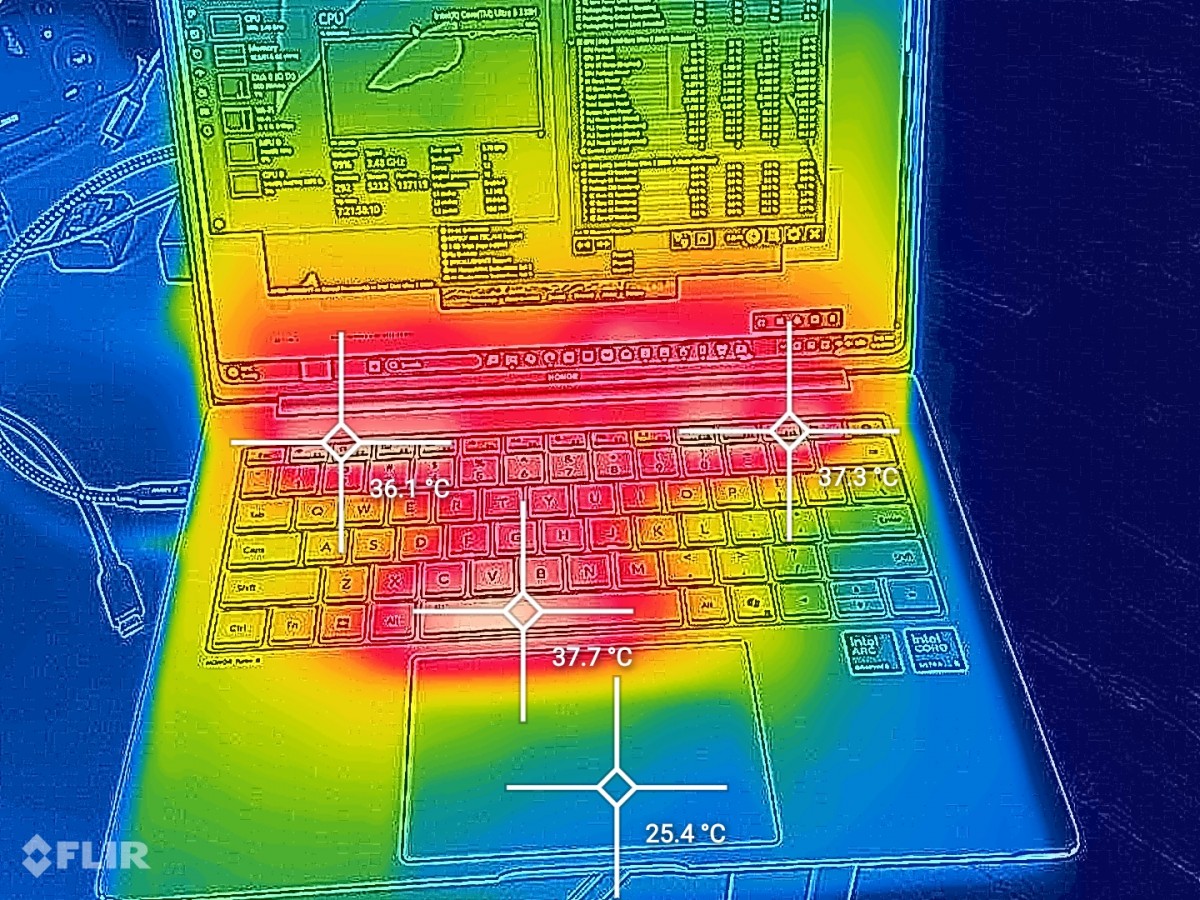
As you can see from the thermal images, the laptop’s keyboard, trackpad and palm rest remained comfortably cool during the extreme test.
Finally, let’s talk about battery life. The Honor MagicBook Pro 14 (2026) offers a promising recipe for long runtimes with a 3nm processor, efficient cooling, and a large 92Wh battery. Of course, the endurance of the OLED panel may also play a role.
We set the screen to 250 nits, 60 Hz and ran two tests: browsing and streaming YouTube (at 60 dB). Honor MagicBook Pro 14 (2026) It lasted 10 hours and 27 minutes in our browsing test, and an impressive 13 hours and 50 minutes in our streaming test..
It took about 70 minutes to charge from 0% to 100% with a 100W charger.
decision
The Honor MagicBook Pro 14 (2026) is a complete laptop and can do it all. Apart from heavy gaming and dedicated 3D workflows, this is a very capable machine. Of course, it is multimedia and office work that the MagicBook Pro 14 (2026) will be best suited for.
It’s a little heavier than the Art Series, but this is compensated for by a larger battery and a regularly placed camera – no magnets here. But the nearly 15-inch screen is still just as great (if not a little better at fighting reflections), it’s brighter at 700 nits, and it’s faster at a 120Hz refresh rate (though keeping it at 60Hz means better battery life).
However, like the MagicBook Art series, the MagicBook Pro 14 (2026) is impressively light and thin, and in our White review color it weighs a little more than your average laptop in the segment.
The problem is finding the laptop. At the time of writing, Honor is still selling the 2025 model on most of its global websites. In the UAE, the laptop is priced at AED 4,299 (£870, €1,075, converted), while in China, it is priced around CNY 8,199 (£890, €1,030, converted). Expect much higher local prices when the laptop finally reaches Germany, France, and the UK.
Pros
- Excellent overall package.
- Panther Lake Intel processors are powerful and efficient.
- Stellar sustained performance, fantastic thermals.
- Great port selection – USB-C, USB-A, HDMI.
- Color-accurate OLED display with 500 nits SDR and 700 nits HDR brightness.
- Good battery life.
Shortcoming
- not widely available
- No Vajra 5.
- We would have liked a USB-C port for charging on the right side. There is no USB-A on the left side.
- The SSD could have been PCIe 5.0.
- No dynamic refresh rate like some Huawei laptops.