



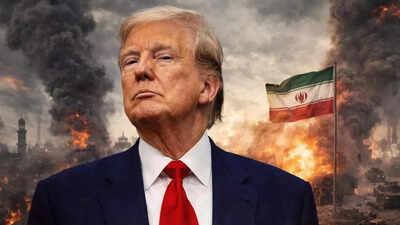
 “We have defeated and completely destroyed Iran,” Trump declared in his first live address to Americans on the war on Wednesday. “They have been destroyed militarily and economically and in every way,” he said. Trump also said that Iran’s “radar has been 100% destroyed” and claimed, “As a military force we are invincible.”But those sweeping claims were quickly challenged by events on the ground.
Two plane incidents crippled the triumphant tone
An American fighter plane was shot down in Iran on Friday in the first such incident since the war began. One crew member was rescued, while another went missing, prompting a US search and rescue operation.In a separate incident, Iranian state media claimed that a US A-10 attack plane crashed in the Persian Gulf after being hit by Iranian security forces. News agency AP quoted a US official speaking on condition of anonymity as saying it was not clear whether the plane had crashed or was shot down.The developments come just days after Trump said Iran has “no anti-aircraft equipment,” making the incidents particularly damaging to his effort to project total military dominance.Trump did not appear publicly on Friday as battlefield setbacks cast doubt on his earlier triumphant characterization of the war.
Trump decides to launch ‘America alone’ into conflict
Trump’s trademark political style – built on certainty, individual authority and unilateral action – is clashing with the unpredictability of war.Trump’s decision to enter war with Israel, without consulting Congress or key allies, has left Washington increasingly isolated.Julian Zelizer, a Princeton University historian, summarized the dilemma in comments to the AP, saying, “You can be the most outspoken, aggressive president in the world but you can’t control what happens abroad.”As the war enters its sixth week, these tensions are becoming even more apparent.
As Trump struggles to garner support, allies are pulling back.
Some of America’s traditional allies are now openly distancing themselves from Washington’s decision to go to war.French President Emmanuel Macron said this week that the US “can hardly complain after this about not being supported in an operation they decided to carry out alone.”“This is not our operation,” Macron said.British Prime Minister Keir Starmer has also refused to get involved in the conflict despite sharp criticism from Trump. Britain and France are instead focusing efforts on helping reopen the Strait of Hormuz after the fighting ends.Trump’s former national security adviser John Bolton, now a critic, said the administration made a “serious mistake” by not building an international coalition before the war.“If you don’t build your coalition before the war, it’s much harder to build it while it’s in it,” Bolton said.Still, Bolton warned European leaders against opposing Trump simply because they are frustrated by his lack of consultation, calling that approach “juvenile and irascible.”

Strait of Hormuz pressure deepens economic decline
Trump is also struggling to contain the broader economic consequences of the conflict.Iran has largely closed the Strait of Hormuz, blocking global oil and gas flows, disrupting energy shipments and sending gasoline prices sharply higher in the United States.The war is destabilizing economies around the world as Iran targets Gulf energy infrastructure and tightens its grip on oil and natural gas transit through the strait.Trump has reportedly asked world leaders for help in reopening the vital waterway, but those offers have been rejected. Some allies want the fighting to end before the issue is dealt with, while others are openly critical of the war Trump has chosen to start.
Mediation efforts continue as Iran signals conditional openness
Despite the fighting, diplomatic channels have not been completely closed.Mediators from Pakistan, Türkiye and Egypt are still trying to bring Washington and Tehran back to the table. Two regional officials quoted by AP said an agreement to stop the war and reopen the Strait of Hormuz was being explored, potentially paving the way for talks in Pakistan.Iranian Foreign Minister Abbas Araghchi said on Saturday that Tehran “has never refused to go to Islamabad”, but stressed that Iran “wants a decisive and permanent end to the illegal war imposed on us.”He also reiterated that position in a separate social media post.The broader regional picture of the latest developments in the war shows how far the conflict has spread.The United Arab Emirates said its air defenses intercepted 23 ballistic missiles and 56 drones from Iran on Saturday. Bahrain, which hosts the US Navy’s 5th Fleet, reported eight drone attacks in 24 hours, bringing the total to 188 missiles and 453 drones hit since the war began.Debris from the captured drone damaged the exteriors of two buildings in Dubai, including that of Oracle, an American tech firm. There is no report of anyone being injured.Iran has also indicated to increase maritime pressure. Parliamentary Speaker Mohammed Bagher Qalibaf made an indirect threat regarding another major global shipping chokepoint, the Bab el-Mandeb Strait. Any disruption there would force ships to reroute around southern Africa, making driving costs even higher.
Trump’s pervasive loner style also faces limits domestically
The Iran war reflects a broader pattern in Trump’s presidency: acting first, often alone, and believing that political force can overcome institutional resistance.Trump also said this week that congressional approval was “not necessary” for the White House ballroom project despite the judge’s ruling. He signed an executive order to create a national list of verified eligible voters and restrict mail-in voting, and even made an unprecedented appearance at the Supreme Court as his administration defended an executive order restricting birthright citizenship.But the strategy is also hitting domestic hurdles. The Supreme Court struck down his sweeping tariff program, Democrats immediately challenged his voting order, and judges appeared skeptical of his effort to curb birthright citizenship.Trump mocked the limitations of his office in a revelation during an Easter luncheon at the White House.“I’m a king who can’t get a ballroom approved,” he said, drawing laughter from Cabinet members and religious leaders. “I’m doing a lot. But I could do a lot more if I were king.”