



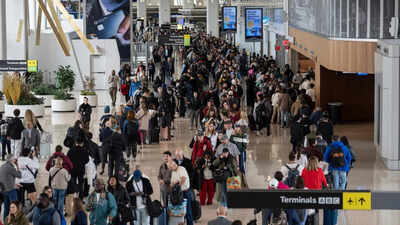

Passengers waiting in TSA line at US airport
The ongoing funding impasse in the US Congress has put pressure on aviation security operations, with the Transportation Security Administration (TSA) warning of possible airport closures and a sharp increase in workplace challenges, including dealing with assault incidents, amid the tense situation.Testifying before the House Homeland Security Committee, Acting TSA Administrator Ha Nguyen McNeil described the situation as increasingly untenable, citing staffing shortages, financial distress among workers, and operational risks at major airports.“This is a serious situation,” she testified, warning of possible airport closures. “At this point, we have to look at all the options that are on the table. And that requires us, at some point, to make very difficult choices about which airports we can try to keep open and which airports we may have to close as our callout rates increase.”They also noted a significant increase in violence against personnel, noting that TSA officers have faced more than a 500 percent increase in attacks since the shutdown began. “This is unacceptable and will not be tolerated,” McNeil said.The agency is also struggling with high absenteeism, with callout rates reported to exceed 40 percent in some locations. More than 480 TSA officers have resigned during the prolonged closure, further straining operations.McNeil highlighted the personal impact this has had on staff, many of whom have been without pay for several weeks. “Some are sleeping in their cars, selling their blood and plasma, and working second jobs to make ends meet, while they are expected to perform at the highest level in uniform to protect the traveling public,” he said.Its impact is already visible at airports. Long security queues have stretched for hours in some places, with officials warning that delays could get worse if the standoff continues. In Houston, understaffed checkpoints are causing checkpoints to operate at a fraction of normal capacity, leading to wait times of up to four hours.ICE agents have been deployed to several U.S. airports to assist with ID checks and crowd management amid TSA staffing shortages during the DHS shutdown. Despite being trained to use TSA equipment, their expanded role has raised concerns among travelers over authority and potential targeting.While Republican leaders have proposed partial funding measures, Democrats are pushing for changes in enforcement practices, including more oversight and restrictions on operations. Both sides have accused the other of prolonging the crisis, with no immediate solution in sight.Beyond aviation security, officials warned that other agencies are also under pressure. The Federal Emergency Management Agency’s disaster relief funds are close to being exhausted, raising concerns about its ability to sustain long-term response efforts if the shutdown continues.Amid the talks deadlock, officials say the risks to vital services from airport security to disaster response are growing by the day.