


Anil Sharma expressed concern over Salim Khan’s health, prayed for his recovery.
Filmmaker Anil Sharma took to social media to pray for the health of veteran screenwriter Salim Khan and wished him a speedy recovery. Khan was admitted to Lilavati Hospital on February 17 after reportedly suffering a blood clot.


Filmmaker Anil Sharma expressed concern over the health of veteran screenwriter Salim Khan after he was put on a ventilator. The 90-year-old was admitted to Lilavati Hospital on Tuesday morning after minimal brain hemorrhage.
Sharma shared a clip of a newspaper article about Salim Khan’s health on X and wrote, “I was worried to hear about Salim Khan Sahab’s health. I pray that he gets well soon and returns home. His Kalam is the identity of our cinema. God give him a long and healthy life.(I am very worried to hear about the health of Salim Khan Sahab. I pray that he gets well soon and returns home as soon as possible. His pen is the identity of our cinema. May God bless him with a long and healthy life).”
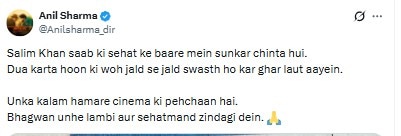
Sharma’s message shows how much Khan is respected in the industry.
Doctors told this to the media on Wednesday afternoon Khan was initially expected to undergo surgery. However, the process has been put on hold for now as he is under observation.
Many celebrities and close family members reached Lilavati Hospital to check on his condition and offer prayers. Poet, lyricist and screenwriter Javed Akhtar went to the hospital twice.
Akhtar and Salim Khan wrote several blockbuster films in the 1970s and early 1980s, including Sholay, Zanjeer, Deewaar, Trishul, Shakti and Mr. India.

Together, the pair played a pivotal role in shaping the “angry young man” ideal that dominated Hindi cinema of that era, a persona most famously embodied by Amitabh Bachchan.
Salim Khan’s legacy in Hindi cinema is considered profound by peers and critics. Teaming up with Javed Akhtar in the late 1960s, the duo known as Salim-Javed changed the style of Bollywood storytelling, introducing themes and characters that would redefine the industry and help usher in the era of the ‘Angry Young Man’ in Indian films.
Their collaborative work set a new standard for screenwriting and narrative production, with films that remain influential decades later. Salim Khan’s last credit as a screenwriter was the 1987 film mr indiaFurther strengthened his influence on the industry. The support received from actors, filmmakers and fans reflects the enduring respect for his contribution.