



Rahu Ketu review: A mythological misfire that forgets its story
Rahu Ketu movie review: The film starring Pulkit Samrat and Varun Sharma struggles to justify its ambitious mythological premise, collapsing under weak writing, confused mythology and a narrative that goes nowhere.

cast Crew

Pulkit Samrat

Piyush Mishra
To create a basic, entertaining piece of professional social cinema you need two things: a story that speaks to your audience, and performances that inspire you to stay invested. Rahu KetuA Hindi mythological social drama directed by Vipul Vig, fails the first requirement so badly that the second never really gets a chance to matter.
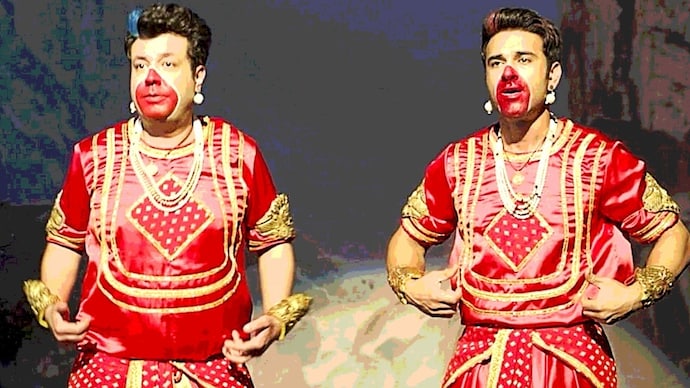
Pulkit Samrat plays the role of Ketu, while Varun Sharma, inclined towards slapstick, plays Rahu. Their brotherly banter works sporadically, offering glimpses of charm, but is largely drowned in an excess of noise, distractions and misplaced ambition. The central idea sounds bizarre on paper: two divine characters written into existence by a mysterious author whose diary has the power to reveal reality. His mission is to eliminate corruption in Himachal Pradesh. The setting, at least, does its job: lush green hills, misty roads, postcard frames. But the story refuses to move forward with the same purpose as the camera.
In Hindu mythology, Rahu and Ketu are not gods who provide justice. They are the severed head and tail of the demon Swarbhanu, who was punished by Lord Vishnu for stealing a sip of nectar during the churning of the ocean. Immortal yet impermanent, they exist as shadow planets in Vedic astrology: Rahu represents desire, illusion and passion, and Ketu symbolizes renunciation and spiritual upliftment.
In Rahu KetuHowever, both are reimagined as benevolent vigilantes rendering moral judgments based on karma. This is not a creative reinterpretation, but a wholesale rewrite, with shocking confidence and little research. Even if one puts aside the mythical freedom and judges the film as an independent fantasy, the problems multiply. The narrative is non-linear to the point of exhaustion, hopping from one hill to the next without settling into rhythm or intention. Scenes come, strangely persist, and disappear without any consequence.
Pulkit Samrat and Varun Sharma share a good friendship and their off-screen chemistry is also visible. But on-screen, it goes nowhere. His characters drift about like the audience in the film, unsure of who they are, why they exist, or what exactly they are supposed to do when they discover that their lives are being written by someone else. The revelation feels meta and interesting, but the film has no answer to its own question. The awareness, struggle and momentum never really comes.
The script lacks the basic architecture of storytelling. It has no clear beginning, no rising middle, and no end. The conflict is unclear, the climax is inconsistent, and almost every character’s motivations are incomplete. Shalini Pandey’s ‘Drug Queen’ is a particularly confusing creation, written as a strange combination of forceful, cruel, insensitive and oddly clueless. She has no real chemistry with either of the leads and even less of a purpose.

Piyush Mishra is once again shown as the old, mysterious writer-poet-futurist-speaker who is painfully doomed. His presence promises depth, philosophy, and subtext, but the film uses him as little more than a prop, another idea introduced without commitment. Such is the fate of Chunky Pandey, who is playing the character of an Israeli gangster settled in the mountains. The irony is that a film about a man who writes stories struggles to hold your attention for more than a few minutes.
What is a seal after all? Rahu KetuHis dealings with Himachal Pradesh are his destiny. The state has been reduced to a stereotype – a drug-infested playground for illegal businesses and exotic escapism. A place that could have been a vibrant character in the story becomes nothing more than a beautiful backdrop for chaos. In fact, at some point, you’ll feel bad staring silently at the hills while the movie plays, perhaps even wondering like us how it all went so wrong.
Rahu Ketu It doesn’t even deserve a spot in a kid’s bedtime story, let alone being expanded into a full-length feature. It’s not a genre without substance, it’s not. Perhaps a tired mess that you forget even when you look at it.