



Amazon is now using hidden markers to detect seal tampering, you should check and be careful of the pink dots
Amazon’s new heat-sensitive tape is showing pink dots on parcels. The intention seems to be to help customers detect whether a package has been tampered with before delivery.


Amazon seems to have quietly rolled out a new feature that, according to online user reports, will instantly reveal if someone tried to tamper with the packaging seal before delivery. The company hasn’t publicly announced or acknowledged any such rollouts, but social media platforms like
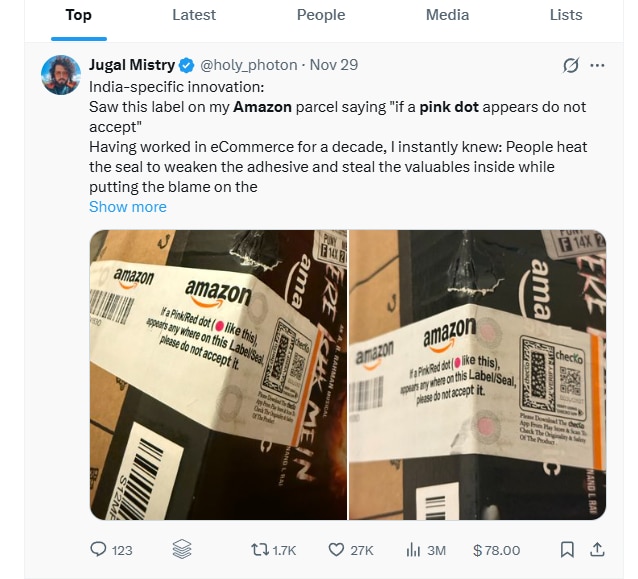
The first major post came from an X user named Jugal Mistry, who says he has worked in the e-commerce sector for about ten years. He shared an image of the new label printed on his Amazon parcel, as well as showing how the seal reacts to heat. “India-specific innovation: Saw this label on my Amazon parcel that read, ‘If pink dot appears, do not accept’ Sure enough, I heated the tape, and it appeared pink dots,” he wrote, explaining that heating is a common trick used by people attempting to weaken the adhesive and access the contents without completely breaking the packaging.
Another user, known by the handle Cycle Chain Shankar, posted a video and several photos showing similar marks on his delivery. His caption read, “Also @amazonIN, when does the pink dot appear? When the contents are taken, and it is repacked. The last image is a good 30 minutes after opening.” His post revealed that if the tape on the package is removed properly without the heating process the dot is not visible. This shows that Amazon’s new delivery feature can be hit or miss on a case-by-case basis, even if it seems like a step in the right direction.
Is Amazon’s goal to prevent tampering with delivery packages?
Amazon did not respond to India Today Tech’s requests for comment. But this comes at a time when online sales and by extension, their deliveries are seeing an increase in volume, especially with the holiday season going on. As high-value categories like electronics and small gadgets account for a significant share of purchases, complaints about tampered parcels are common on many online platforms, not just Amazon. Over the past few years, many customers have reported receiving bars of soap instead of smartphones, detergent packets instead of shoes, and other replacement items. In most of these cases, the packaging appeared to be almost intact, making it difficult to immediately identify the defect.
While platforms often replace such orders or offer refunds, India TV reported that several incidents involve delivery staff allegedly heating the tape, opening the box, removing the contents and then sealing it in a way that conceals the interference. This method leaves almost no visible trace, and by the time the customer opens the parcel, the swap has already taken place.
Amazon’s new tape likely aims to eliminate those cases. According to users who have experienced it, the seal contains a heat-sensitive chemical that develops pink or red spots when exposed to high temperatures. The marking is subtle when the package is fresh, but as soon as someone tries to lift or heat the tape, the chemicals react and reveal a bright dot that cannot be hidden again. It works somewhat like the thermal fraud-detection labels used in secure packaging, but appears to be tailor-made for the Indian market, where delivery-related scams have been a long-running challenge.

The latest social-media posts suggest that Amazon has started using this tape on some scale, especially for electronics and premium goods. If you have an Amazon delivery coming soon, it might be worth taking a look at the seal before opening it. Any visible pink stain, even a slight one, may indicate that someone may have attempted to tamper with the package before it reached you.
For now, the rollout is gaining attention through customer posts rather than an official announcement. But reactions show that the simple color-changing mechanism is doing exactly what it’s meant to do: alerting shoppers in real time and deterring anyone trying to open the parcel mid-passage.