



Shashi Shekhar Vempati defends Sanchar Saathi pre-install order, calls snooping fears ‘exaggerated’

In this special report, Shashi Shekhar Vempati, co-founder of Deep Tech for India, defends the government’s directive to pre-install the Sanchar Sathi app on smartphones. Addressing concerns about potential state surveillance, the former CEO of Prasar Bharati has described such fears as ‘baseless and exaggerated’. They argue that the move is a ‘positive step’ to tackle the ‘huge fraud’ and ‘digital arrest’ cases plaguing India. Emphasizing its role in public interest and cyber security, Vempati highlighted that the app empowers users to block stolen phones and check fraudulent connections.
latest video

PMO renamed as ‘Seva Teerth’: Modi government pushing to end ‘Macaulay mentality’
In this special report, the focus is on the renaming of the Prime Minister’s Office to ‘Seva Tirtha’ as part of the government’s effort to decolonize Indian institutions. Prime Minister Narendra Modi claims that ‘An Englishman named Macaulay sowed the seeds to uproot India from its roots’ (An Englishman named Macaulay sowed the seeds to uproot India from its roots). The event, hosted by Gaurav Sawant, debates whether this shift from ‘satta’ (power) to ‘seva’ (service) is a genuine cultural reset or merely ‘nominal government’, as alleged by the Congress. The guests include BJP’s Charu Pragya, Congress spokesperson Ashpreet Khadiyal, historian Makhan Lal and senior journalist Neerja Chaudhary.
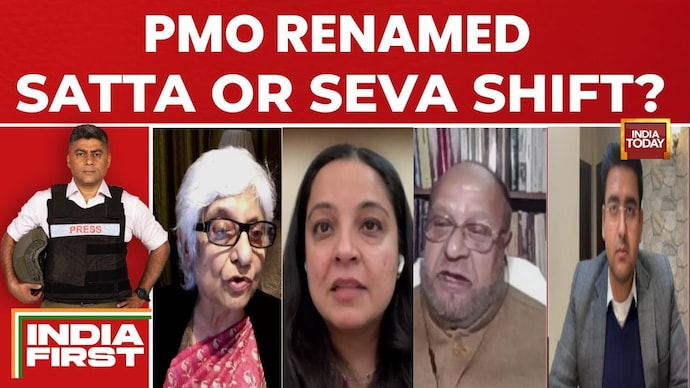
PMO renamed as ‘Seva Teerth’: BJP’s Charu Pragya calls it ‘civilizational reform’, Congress objects
This special report focuses on renaming the Prime Minister’s Office as ‘Seva Tirtha’ and renaming the Central Secretariat as ‘Kartavya Bhawan’. BJP national spokesperson Charu Pragya defended the move, saying, ‘This is a conscious civilizational reform. We are moving beyond the mentality that a monarchy had in relation to its subjects and what a government should have. Congress spokesperson Arshpreet Khadiyal hit back saying BJP is a ‘name changer government, not a game changer government’ which is being used to divert attention. Senior journalist Neerja Chaudhary argues that the shift from ‘power’ to ‘service’ is desirable, but the country needs to go beyond names to fight the ‘slave mentality’. Historian Professor Makhanlal cites historical precedents for such changes.

Haryana sports tragedy: Para-athlete murdered, teenage player crushed to death; Deependra Hooda blamed BJP’s ‘indifference’
A significant controversy has emerged over the Indian government’s directive to pre-install the ‘Sanchar Sathi’ app on all smartphones, sparking a heated debate over privacy and potential surveillance. Responding to allegations of spying by opposition leaders like Shiv Sena’s (UBT) Priyanka Chaturvedi and Congress’s Shama Mohammed, Union Telecom Minister Jyotiraditya Scindia has said that the app is optional and can be removed. This political clash is coupled with serious news from Haryana, where the law and order and state of sports infrastructure is being scrutinized following the murder of national para-athlete Rohit Dhankhar and the death of 16-year-old basketball player Hardik Rathi after being hit by a pole. Congress MP Deepender Hooda has criticized the BJP government for alleged ‘criminal negligence’. The report also covers the renaming of the Prime Minister’s Office to ‘Seva Teerth’ and the ‘Naughty Chicken’ breakfast meeting between Karnataka CM Siddaramaiah and DK Shivakumar.


To decolonize institutions, PMO will be renamed as ‘Seva Tirtha’ and Raj Bhavans will be renamed as ‘Lok Bhawan’
In this news update, the focus is on a major renaming initiative aimed at “decolonizing India’s institutions”. The Prime Minister’s Office (PMO) is set to be renamed ‘Seva Teerth’, while Raj Bhavans across the country will be known as ‘Lok Bhawan’. The report described this as a “Macaulay mentality” of Prime Minister Narendra Modi breaking “colonial chains” and prioritizing an “India first” approach. The opposition has reacted sharply to the move and mocked the administration by calling it a “revenge government” rather than a “quiet government”. The bulletin explores whether this “cultural reset” represents merely a symbolic change or a significant change in governance.